
Dold 0068157 semiconductor contactor AC110-240V AC10A
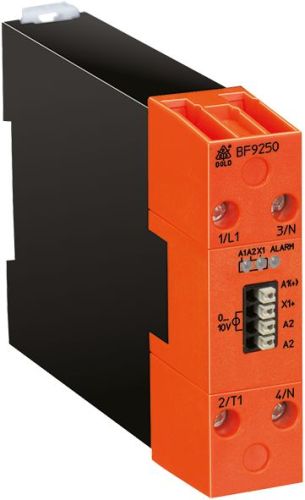
Dold 0068157 semiconductor contactor AC110-240V AC10A
| Lieske Part No. | 1001498 |
|---|---|
| Mfg Part No | 0068157 |
| EAN-Code | 4030641681579 |
| Manufacturer | Dold |
| Here only | 210,30 EUR
250,26 EUR incl. VAT
|
Further information for Dold 0068157 semiconductor contactor AC110-240V AC10A
| Technical data | |
| Analog Input Control | 4 - 20 mA |
| Approvals | UL |
| Load current up to | 50 A |
| Load voltage up to | AC 480 V |
| Number of poles | 1-pole |
| Width | 22,5 mm, 45 mm, 90 mm |
| Type | BF 9250/0_2 |
| Temperature monitoring | |
| Variant | |
| Auxiliary voltage | AC/DC 24 V |
| Contact equipping | without signal contact |
| Control input | DC 0 - 10 V |
| Load current | AC 10 A |
| Load voltage | AC 110 - 240 V |
| Semiconductor output | 1-pole |
| Approvals and Markings | UL-listed C/US |
| Variant | Self optimising, to achieve as short as possible control periods, suitable for infrared lamps |
Applications include the control of electric heaters in production plants, drying processes or in process engineering, where precise and disturbance-free temperature control is required. The device is designed for use in industrial environments that require reliable and low-maintenance switching technology. The zero-voltage switching function ensures noiseless and disturbance-free switching, which is particularly advantageous for sensitive processes.
Functions and equipment in detail include a varistor protection circuit, which protects the device against overvoltages, as well as temperature protection for the power semiconductor, which triggers a shutdown in case of overheating. The LED indicator signals the operating status: green LED for auxiliary voltage, yellow LED for output status, and red LED for alarms. The red LED lights up in case of a synchronisation error, a fault in the control input, or overheating of the semiconductor. The overheating message is latching and requires a brief interruption of the supply voltage to reset.
Technology explained simply is based on the use of semiconductor components that function as electronic switches. Unlike mechanical relays, switching occurs without moving parts, resulting in a longer service life and reduced maintenance. The pulse packet control enables fine adjustment of power by switching the load in short pulses. The output power resolution for this variant is 5 %, enabling precise adjustment of heating power to process requirements. The zero-crossing detection ensures that the switch only operates at the moment of voltage zero crossing, minimising electrical interference.
Compatibility and accessories include use with control devices providing an analogue output in the range DC 0–10 V or DC 4–20 mA. The devices are designed for loads in the range AC 230–480 V and up to 50 A, with the width varying according to rated current: 22.5 mm for 10 A, 45 mm for 25 A, and 90 mm for 50 A. The device is snap-on mountable on DIN rail, enabling easy integration into enclosures. Certifications according to IEC/EN 60947-4-2 and IEC/EN 60947-4-3 as well as UL listing C/US confirm compliance with international safety and quality standards.
Mounting and installation require adherence to recommended clearances: 20 mm above and below to the cable duct, and 10 mm to the left and right, to ensure sufficient cooling. The operating temperature ranges from 0 to 40 °C, with current derating occurring at higher temperatures. The maximum air humidity is 75 % without condensation. The devices are designed for continuous operation and feature integrated overload protection as well as reverse polarity protection at the control input.
Operational advantages include high service life, noiseless operation, and precise control. The absence of mechanical wear reduces maintenance costs. The LED indicators enable quick diagnosis of operating conditions and faults. The self-optimised pulse distribution ensures particularly fast response to load changes, which is advantageous for dynamic processes. The devices are designed for use in industrial environments where reliability and safety are paramount.

This is an offer of:
79279 Vörstetten
https://industry-electronics.com
Tel. 07666/88499-0
Fax. 07666/88499-111
Diesen Artikel finden Sie unter:
industry-electronics.com/artikel/1001498

Lieske Elektronik e.K.
Reutener Str. 1079279 Vörstetten
https://industry-electronics.com
Tel. 07666/88499-0
Fax. 07666/88499-111
Diesen Artikel finden Sie unter:
industry-electronics.com/artikel/1001498