
Dold 0067791 semiconductor contactor AC48-480V AC15A
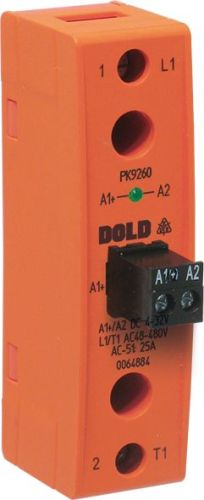
Dold 0067791 semiconductor contactor AC48-480V AC15A
| Lieske Part No. | 1001562 |
|---|---|
| Mfg Part No | 0067791 |
| EAN-Code | 4030641677916 |
| Manufacturer | Dold |
| Here only | 60,07 EUR
71,48 EUR incl. VAT
|
Further information for Dold 0067791 semiconductor contactor AC48-480V AC15A
| Technical data | |
| Approvals | UL, UL-Recognized |
| Load current up to | 88 A |
| Load voltage up to | AC 600 V |
| Number of poles | 1-pole |
| On/Off Input Control | AC, AC/DC, DC |
| Width | 22,5 mm |
| Type | PK 9260 |
| Variant | |
| Control voltage | AC 100 - 230 V |
| Load current | AC 10 A |
| Load voltage | AC 48 - 480 V |
| Semiconductor output | 1-pole |
| Approvals and Markings | UL-listed C/US |
| Variant | Switching at zero crossing. M4 flat terminal. With heat sink |
Applications
This semiconductor relay is suitable for applications in the plastics and rubber industry, packaging machines, soldering systems, and the food industry. It is frequently used in injection moulding machines or other machinery where high switching frequency and long service life are required. The zero-voltage switching function makes it particularly suitable for systems where disturbance-free switching of heating or cooling circuits is necessary.
Functions and Features in Detail
The device features two antiparallel-connected thyristors responsible for the switching function. The DCB technology (Direct-Copper-Bonding process) ensures excellent heat transfer, reducing thermal stress and increasing service life. An LED indicator displays the status of the control input, allowing the operating condition to be visually checked. The connection type is a flat M4 terminal, enabling secure and quick connections. The width is 22.5 mm, allowing use in compact enclosures.
Technology Explained Simply
The zero-voltage switching function means the relay does not switch abruptly, but at the next voltage zero crossing. This prevents arcing and disturbances in the power grid, especially with resistive loads. The peak blocking voltage is up to 1600 V, and the insulation voltage is 4000 V, ensuring high electrical safety. The turn-on delay is maximum 10 ms plus half a cycle, and the turn-off delay is maximum 35 ms plus half a cycle, depending on the control voltage. These values are typical for semiconductor relays and ensure reliable switching performance.
Compatibility and Accessories
The semiconductor relay is equipped with a heatsink that can be snapped onto a DIN rail. This allows for easy installation in enclosures and optimal heat dissipation. Alternatively, the device can be mounted onto existing cooling surfaces using two screws. The use of special super-fast fuses is recommended to protect the device against short circuits. Certifications include UL-listed C/US and UL-Recognized, enabling use in corresponding markets. Compliance with standards is achieved according to IEC/EN 62314 as well as IEC/EN 60947-4-2 and -4-3.
Mounting and Installation
Mounting is done either by snapping the heatsink onto a DIN rail or by securing it with two screws onto a cooling surface. The terminals are designed for secure connections, with the M4 flat terminal enabling quick and reliable connections. When mounting multiple relays side by side, sufficient cooling and ventilation must be ensured to avoid overheating.
Operational Advantages
The semiconductor relay offers high switching frequency and long service life due to its wear-free operation. It is noiseless and resistant to vibration and shock, making it particularly suitable for industrial environments. The compact design with only 22.5 mm width enables space-saving installation. The LED indicator simplifies maintenance and diagnostics, as the operating status is directly visible. The use of DCB technology ensures efficient heat dissipation, increasing reliability.

This is an offer of:
79279 Vörstetten
https://industry-electronics.com
Tel. 07666/88499-0
Fax. 07666/88499-111
Diesen Artikel finden Sie unter:
industry-electronics.com/artikel/1001562

Lieske Elektronik e.K.
Reutener Str. 1079279 Vörstetten
https://industry-electronics.com
Tel. 07666/88499-0
Fax. 07666/88499-111
Diesen Artikel finden Sie unter:
industry-electronics.com/artikel/1001562