
Dold 0067298 PF9029.11 3AC400V UH=AC230V 10-36A soft start device
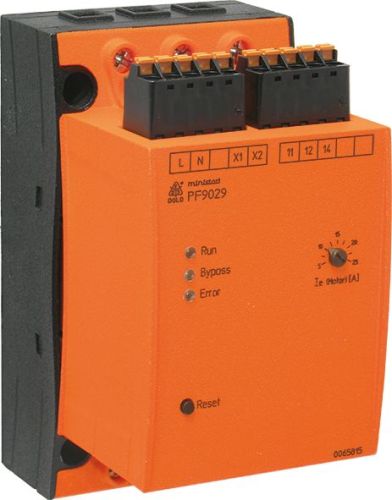
Dold 0067298 PF9029.11 3AC400V UH=AC230V 10-36A soft start device
| Lieske Part No. | 1002151 |
|---|---|
| Mfg Part No | 0067298 |
| EAN-Code | 4030641672980 |
| Manufacturer | Dold |
| Here only | 600,35 EUR
714,42 EUR incl. VAT
|
Further information for Dold 0067298 PF9029.11 3AC400V UH=AC230V 10-36A soft start device
| Technical data | |
| Extra functions | Mains monitoring, Temperature monitoring |
| For three-phase motors, 400 V up to | 18,5 kW |
| Load voltage up to | 3AC 460 V |
| Width | 67,5 mm |
| Type | PF 9029 |
| Auxiliary voltage required | |
| Signalling output | |
| Variant | |
| Auxiliary voltage | AC 230 V |
| Contact equipping | 1 changeover contact |
| Load voltage | 3AC 400 V |
| Nominal current | 10 - 36 A |
Applications
The device is primarily intended for use in heat pumps, particularly for drives with three-phase compressors. It is suitable for applications where a gentle, disturbance-free motor start is required to avoid network loading and increase operational safety. The integrated monitoring functions make it a compact solution package for soft starting, motor protection, and network monitoring in a single device.
Functions and Equipment in Detail
The PF9029.11 features integrated network monitoring that detects under-voltage (below 330 V for more than 1 second) and over-voltage (above 470 V for more than 1 second). Phase sequence monitoring ensures that the three-phase network has a clockwise rotation; a fault is triggered if a counter-clockwise rotation is detected. An integrated motor protection according to Class 10 as per IEC/EN 60947-4-2 protects the motor against overloads. Additionally, the temperature of the power semiconductors is monitored to prevent overheating. The function for detecting a missing load connection prevents the motor from running on two phases. Automatic frequency detection of the load voltage recognizes frequencies in the range of 50 Hz ± 5 Hz or 60 Hz ± 5 Hz. A lock protection in bypass mode detects excessive current draw, which may indicate a mechanical jam.
Technology Explained Simply
The device operates using power semiconductors (thyristors), which during start-up gradually increase the current flow to limit the inrush current. After the motor has reached full speed, the current flow is bypassed using integrated relays, so the semiconductors are no longer loaded. This reduces power loss and increases operational safety. The start time is short: at 25 A it is less than 200 ms, at 36 A less than 300 ms. The contact configuration includes a changeover contact, which serves as an alarm output to transmit operating states or faults to external systems. The control and monitoring electronics continuously monitor multiple parameters and respond to faults with disconnection and a blinking code display on the LED.
Compatibility and Accessories
The device is designed for three-phase AC drives and is compatible with motors up to 18.5 kW at 400 V. The auxiliary voltage of AC 230 V must be provided externally. It is not designed for speed control of drives.
Mounting and Installation
The device is intended for mounting in enclosures and can be installed in standard control panels with a width of 67.5 mm. The terminal connections are designed for connecting load and auxiliary voltage lines. The terminal assignment is described in the datasheet, with attention to phases L1, L2, L3, neutral conductor connection (N), and auxiliary voltage connections (X1/X2). The reset button is used to reset the device after a fault condition.
Operational Advantages
The integrated monitoring functions increase operational safety. Energy savings are achieved by bypassing the power semiconductors after start-up, reducing power loss. The short start time and symmetrical inrush current ensure stable operation. The compact design and combination of multiple functions in a single device reduce space requirements and installation complexity. The display of faults via blinking codes on the LED enables quick diagnosis.

This is an offer of:
79279 Vörstetten
https://industry-electronics.com
Tel. 07666/88499-0
Fax. 07666/88499-111
Diesen Artikel finden Sie unter:
industry-electronics.com/artikel/1002151

Lieske Elektronik e.K.
Reutener Str. 1079279 Vörstetten
https://industry-electronics.com
Tel. 07666/88499-0
Fax. 07666/88499-111
Diesen Artikel finden Sie unter:
industry-electronics.com/artikel/1002151