
Dold 0067266 semiconductor relay AC48-480V AC25A
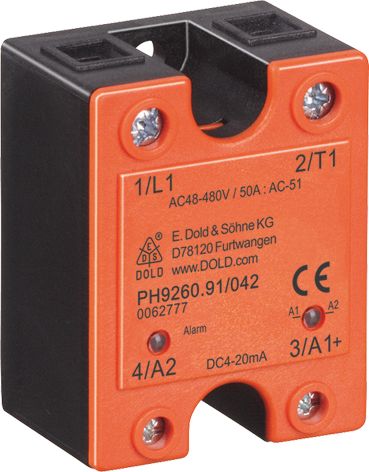
Dold 0067266 semiconductor relay AC48-480V AC25A
| Lieske Part No. | 1001327 |
|---|---|
| Mfg Part No | 0067266 |
| EAN-Code | 4030641672669 |
| Manufacturer | Dold |
| Here only | 80,69 EUR
96,02 EUR incl. VAT
|
Further information for Dold 0067266 semiconductor relay AC48-480V AC25A
| Technical data | |
| Analog Input Control | 4 - 20 mA |
| Load current up to | 50 A |
| Load voltage up to | AC 480 V |
| Number of poles | 1-pole |
| Width | 45 mm |
| Type | PH 9260/042 |
| Variant | |
| Control current | DC 4 - 20 mA |
| Load current | AC 25 A |
| Load voltage | AC 48 - 480 V |
| Semiconductor output | 1-pole |
| Variant | Without heat sink |
Applications
This semiconductor relay is particularly suitable for controlling heating elements and infrared lamps. It is used in systems requiring precise temperature control, such as injection moulding machines in the plastics and rubber industry, thermoforming and packaging machines, as well as in the food industry. The zero-voltage switching technology enables noiseless and fast switching, extending the service life of connected loads and improving EMC performance.
Functions and equipment in detail
The device operates with two antiparallel-connected thyristors and switches always at the zero crossing of the sinusoidal mains voltage. This ensures minimal disturbance to the electrical supply and high EMC compatibility. The output is activated proportionally to the control current, with a control current of 4 to 20 mA being converted into an on/off ratio of 0 to 100 %. Two LEDs serve as status indicators: a yellow LED indicates the operating voltage and control current, with the blinking cycle corresponding to the set on/off ratio. A red LED indicates fault conditions, for example, when the control current is below 4 mA (slow blinking) or above 21 mA (fast blinking).
Technology explained simply
Pulse packet control enables self-optimised distribution of switching pulses with minimised cycle times. This achieves precise temperature control, which is crucial for many industrial processes. The zero-voltage switching technology ensures that the switch is activated at the moment of voltage zero crossing, minimising electrical interference and increasing the service life of the load. The maximum forward voltage is 1.2 V at 25 A load current and 1.4 V at 50 A. The peak reverse voltage is 1200 V, and the voltage rate of rise is 500 V/μs.
Compatibility and accessories
The semiconductor relay is available in a version without a heatsink. Optionally, it is also available with a heatsink for mounting on a DIN rail, enabling optimal heat dissipation. For thermal protection, a temperature limit switch, for example, type UCHIYA UP62-100, can be inserted into a designated pocket on the underside of the device. This switch opens when the heatsink temperature exceeds, for example, 100 °C, thus protecting the device from thermal overload.
Mounting and installation
The device has a width of 45 mm and is designed for mounting on a DIN rail. The connection terminals are box terminals, with the load connections secured using M4 Pozidriv screws. The permissible wire cross-section is 1.5 mm² for the control input and 10 mm² for the load circuit. The tightening torque is 1.2 Nm. The protection class for shock protection is IP20, providing protection against contact with moving parts and against solid foreign objects up to 12.5 mm in diameter.
Advantages in operation
Due to the zero-voltage switching technology and self-optimised pulse distribution, high operational safety and precise temperature control are achieved. The LED indicators enable quick diagnosis of operating conditions and faults. The robust construction and compliance with the standard IEC/EN 60947-4-2 ensure reliable performance in industrial environments. The device is designed for a maximum operating voltage of 35 V DC at the control input, with a burden voltage of max. 8 V. The maximum power consumption at the control input is less than 400 W at 20 mA control current.

This is an offer of:
79279 Vörstetten
https://industry-electronics.com
Tel. 07666/88499-0
Fax. 07666/88499-111
Diesen Artikel finden Sie unter:
industry-electronics.com/artikel/1001327

Lieske Elektronik e.K.
Reutener Str. 1079279 Vörstetten
https://industry-electronics.com
Tel. 07666/88499-0
Fax. 07666/88499-111
Diesen Artikel finden Sie unter:
industry-electronics.com/artikel/1001327