
Dold 0067165 semiconductor contactor PK9260.91/100/06 AC48-600V AC50A
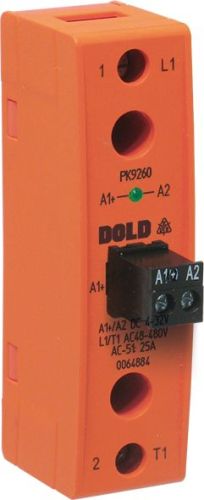
Dold 0067165 semiconductor contactor PK9260.91/100/06 AC48-600V AC50A
| Lieske Part No. | 1001619 |
|---|---|
| Mfg Part No | 0067165 |
| EAN-Code | 4030641671655 |
| Manufacturer | Dold |
| Here only | 122,86 EUR
146,20 EUR incl. VAT
|
Further information for Dold 0067165 semiconductor contactor PK9260.91/100/06 AC48-600V AC50A
| Technical data | |
| Approvals | UL, UL-Recognized |
| Load current up to | 88 A |
| Load voltage up to | AC 600 V |
| Number of poles | 1-pole |
| On/Off Input Control | AC, AC/DC, DC |
| Width | 22,5 mm |
| Type | PK 9260 |
| Variant | |
| Control voltage | DC 4 - 32 V |
| Load current | AC 60 A |
| Load voltage | AC 48 - 600 V |
| Semiconductor output | 1-pole |
| Variant | Switching at zero crossing. With heigh I2t-value. M4 flat terminal. With heat sink |
Applications
This semiconductor relay is intended for use in machine building and automation technology, particularly in injection moulding machines, packaging machines, soldering systems, and in the food industry. It is suitable for frequent, wear-free and noiseless switching of resistive loads, where the zero-voltage switching function extends the service life of the load and the relay. Its use in environments with vibrations and mechanical shocks is possible due to its vibration- and shock-resistant design.
Functions and Equipment in Detail
The device is based on two antiparallel-connected thyristors connected via DCB technology (Direct-Copper-Bonding process) to ensure optimal heat transfer. The LED indicator signals the status of the control input, simplifying operational monitoring. The peak blocking voltage is up to 1600 V, and the insulation voltage is 4000 V, ensuring high electrical safety. The turn-on delay is maximum 1.0 ms plus half a cycle, and the turn-off delay is maximum 1.0 ms plus half a cycle, with exact values varying depending on the control voltage.
Technology Explained Simply
The zero-voltage switching ensures that the relay only switches at the voltage zero crossing, avoiding spark generation and electrical interference. The DCB technology enables efficient heat dissipation, reducing thermal stress on the component. The heatsink allows safe mounting on a DIN rail and supports cooling under high load. The M4 flat terminal provides a secure and quick connection for load terminals.
Compatibility and Accessories
The semiconductor relay is suitable for use with special superflink fuses to prevent short circuits. It can be mounted on existing cooling surfaces using two screws. Actuation is performed via digital signals in AC, AC/DC or DC technology. The UL and UL-Recognized certifications confirm compliance with international safety standards.
Mounting and Installation
Mounting is either directly onto a cooling surface using two screws or with the integrated heatsink onto a DIN rail. The connection terminals are designed for secure connections. When installing multiple relays side by side, sufficient cooling and ventilation must be ensured to avoid overheating.
Advantages in Operation
The device is characterised by high switching frequency, long service life, noiseless operation and high mechanical robustness. The zero-voltage switching reduces load stress and extends the service life of the entire system. The compact design with a width of 22.5 mm enables efficient space utilisation in enclosures. The LED indicator simplifies diagnosis and maintenance.
Certifications and Standards
The device complies with standards IEC/EN 62314 as well as IEC/EN 60947-4-2 and -4-3. The UL and UL-Recognized certifications confirm safety compliance for use in the USA and Canada. Operation must consider environmental conditions and load requirements, with cooling and ventilation being crucial for operational safety.

This is an offer of:
79279 Vörstetten
https://industry-electronics.com
Tel. 07666/88499-0
Fax. 07666/88499-111
Diesen Artikel finden Sie unter:
industry-electronics.com/artikel/1001619

Lieske Elektronik e.K.
Reutener Str. 1079279 Vörstetten
https://industry-electronics.com
Tel. 07666/88499-0
Fax. 07666/88499-111
Diesen Artikel finden Sie unter:
industry-electronics.com/artikel/1001619