
Dold 0066928 RN9075.11/61 3/N AC138-440/78-253V fuse monitor 0-30 s
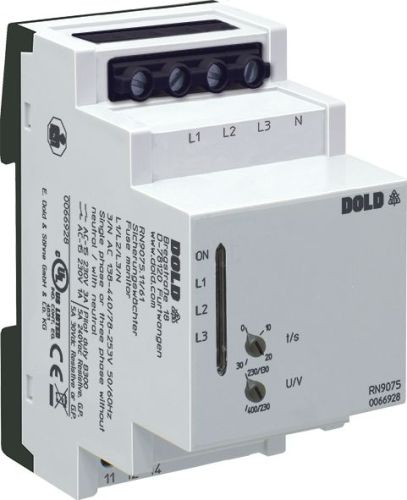
Dold 0066928 RN9075.11/61 3/N AC138-440/78-253V fuse monitor 0-30 s
| Lieske Part No. | 1002175 |
|---|---|
| Mfg Part No | 0066928 |
| EAN-Code | 4030641669287 |
| Manufacturer | Dold |
| Here only | 165,52 EUR
196,97 EUR incl. VAT
|
Further information for Dold 0066928 RN9075.11/61 3/N AC138-440/78-253V fuse monitor 0-30 s
| Technical data | |
| 1- / 3-phase | 1, 3 |
| Approvals | UL |
| Enclosure design | Distribution board |
| Measuring range max. | 3 AC 400 V |
| Output contacts | 1 C/O contact |
| Standard measuring range | 3/N AC 400/230 V |
| Width | 52,5 mm |
| Type | RN 9075 |
| Variant | |
| Contact equipping | 1 changeover contact |
| Operating voltage | 3/N AC 138 - 440 / 78 - 253 V |
| Switching delay | 0 - 30 s |
| Approvals and Markings | UL-listed C/US |
| Variant | De-Energized on trip |
Applications
The fuse monitor is designed for use in industrial and commercial installations where reliable power supply is critical. It is suitable for monitoring fuses in systems with three-phase or single-phase power supply, particularly in applications where power interruption could lead to production downtime or damage. Applications include automatic shutdown or lockout in case of failure of one or more phase fuses.
Functions and equipment in detail
The device detects a phase voltage drop below 0.8 times the operating voltage (0.8 x UB), indicating a blown fuse. Detection is also possible in unbalanced networks and with harmonic distortion, increasing reliability under real operating conditions. Indication is provided via a green LED ON, which lights up when operating voltage is present, and red LEDs for L1, L2 and L3, which light up when voltage drops below 0.8 x UB. The contact configuration includes a changeover contact, serving as an output relay. The contact materials are made of AgNi, ensuring high switching durability and corrosion resistance.
Technology explained simply
The technology is based on voltage measurement after the fuses. When a fuse fails, the voltage drops below the threshold of 0.8 x UB, triggering the device. The switching delay allows for a short delay to filter out brief voltage fluctuations or transients. The operating voltage is directly drawn from the network, eliminating the need for additional auxiliary power supply. The nominal frequency is 50/60 Hz, with a frequency range between 45 and 65 Hz. The nominal power consumption is approximately 7 VA.
Compatibility and accessories
The device is designed for single-phase and three-phase networks with neutral conductor. It is equipped with an installation distributor housing, enabling mounting in standard distribution boxes. The width is 52.5 mm. The connection terminals are provided for phases L1, L2, L3 and neutral conductor N. The output contacts (11, 12, 14) are configured as changeover contacts and can be integrated into existing control and protection circuits. The maximum fuse rating is 5 A gG / gL.
Mounting and installation
Mounting is done in an installation distributor. The connection terminals are clearly labeled (L1, L2, L3, N) and allow for easy wiring. The width of 52.5 mm corresponds to the standard for DIN rail mounting. The operating temperature range is from -20 °C to +55 °C, and the storage temperature range is from -25 °C to +60 °C. The relative humidity is up to 93 % at 40 °C. The operating altitude is limited to below 2000 m.
Advantages in operation
Early detection of fuse failures increases system availability and prevents costly damage. Quick response even with switched-off consumers enables preventive maintenance. Reliability in unbalanced and harmonic-distorted networks makes the device suitable for demanding industrial environments. Simple installation without auxiliary power reduces effort during commissioning. The UL-listed C/US certification ensures use in the USA and Canada. The devices comply with the standard IEC/EN 60255-1.

This is an offer of:
79279 Vörstetten
https://industry-electronics.com
Tel. 07666/88499-0
Fax. 07666/88499-111
Diesen Artikel finden Sie unter:
industry-electronics.com/artikel/1002175

Lieske Elektronik e.K.
Reutener Str. 1079279 Vörstetten
https://industry-electronics.com
Tel. 07666/88499-0
Fax. 07666/88499-111
Diesen Artikel finden Sie unter:
industry-electronics.com/artikel/1002175