
Dold 0066889 semiconductor contactor AC24-240V AC20A
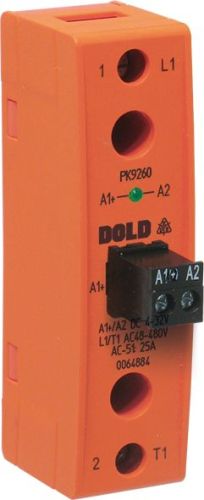
Dold 0066889 semiconductor contactor AC24-240V AC20A
| Lieske Part No. | 1001565 |
|---|---|
| Mfg Part No | 0066889 |
| EAN-Code | 4030641668891 |
| Manufacturer | Dold |
| Here only | 61,75 EUR
73,48 EUR incl. VAT
|
Further information for Dold 0066889 semiconductor contactor AC24-240V AC20A
| Technical data | |
| Approvals | UL, UL-Recognized |
| Load current up to | 88 A |
| Load voltage up to | AC 600 V |
| Number of poles | 1-pole |
| On/Off Input Control | AC, AC/DC, DC |
| Width | 22,5 mm |
| Type | PK 9260 |
| Variant | |
| Control voltage | AC 100 - 230 V |
| Load current | AC 20 A |
| Load voltage | AC 24 - 240 V |
| Semiconductor output | 1-pole |
| Approvals and Markings | UL-listed C/US |
| Variant | Switching at zero crossing. M4 flat terminal. With heat sink |
Applications
This semiconductor relay is suitable for use in machine building and automation technology, particularly in injection moulding machines, packaging machines, soldering systems, and the food industry. It is ideal for applications requiring frequent, wear-free switching without mechanical contact wear. Zero-voltage switching is especially beneficial for resistive loads such as heaters or resistors, as it minimizes switching disturbances.
Functions and Features in Detail
The device consists of two antiparallel-connected thyristors connected via DCB technology (Direct-Copper-Bonding process) to ensure optimal heat transfer. The M4 flat terminal enables secure and quick connection. The LED status indicator shows the operating status of the control input. The peak blocking voltage is up to 1600 V, and the insulation voltage is 4000 V, ensuring high electrical safety. The device is UL-listed C/US and complies with standards IEC/EN 62314 as well as IEC/EN 60947-4-2 and -4-3.
Technology Explained Simply
Zero-voltage switching means the relay does not switch abruptly, but at the next zero crossing of the alternating voltage. This reduces electrical interference and extends service life. DCB technology ensures efficient heat dissipation, which is especially important under high loads. Control is via a digital input that can be operated with both alternating and direct voltage. The LED indicator provides visual feedback on the operating status.
Compatibility and Accessories
The device is equipped with a heat sink that can be snap-mounted onto a DIN rail. Alternatively, the relay can be mounted onto existing cooling surfaces using two screws. The heat sink option facilitates heat dissipation under higher loads. Connection options are selectable: either M4 flat terminal or M5 screw terminal for cable lugs. The use of special superfast fuses is recommended to protect the device against short circuits.
Mounting and Installation
Mounting is either onto a DIN rail using the integrated heat sink or onto existing cooling surfaces using two screws. When mounting multiple devices side by side, sufficient cooling and ventilation must be ensured. The width of the device is 22.5 mm, minimizing space requirements in the enclosure.
Operational Advantages
The semiconductor relay offers high switching frequency, long service life, noiseless switching, and is vibration- and shock-resistant. Its compact design and efficient cooling enable reliable operation even in demanding industrial environments. Zero-voltage switching reduces electromagnetic compatibility (EMC) interference, although additional filters or measures for interference reduction may be required if necessary.

This is an offer of:
79279 Vörstetten
https://industry-electronics.com
Tel. 07666/88499-0
Fax. 07666/88499-111
Diesen Artikel finden Sie unter:
industry-electronics.com/artikel/1001565

Lieske Elektronik e.K.
Reutener Str. 1079279 Vörstetten
https://industry-electronics.com
Tel. 07666/88499-0
Fax. 07666/88499-111
Diesen Artikel finden Sie unter:
industry-electronics.com/artikel/1001565