
Dold 0066881 RL9877.11/120/61 3/N AC80-230/ phase monitor 0-30 s
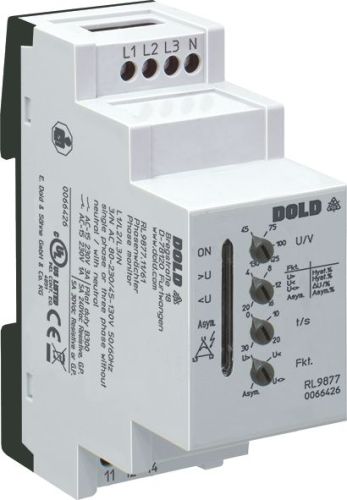
Dold 0066881 RL9877.11/120/61 3/N AC80-230/ phase monitor 0-30 s
| Lieske Part No. | 1002083 |
|---|---|
| Mfg Part No | 0066881 |
| EAN-Code | 4030641668815 |
| Manufacturer | Dold |
| Here only | 161,52 EUR
192,21 EUR incl. VAT
|
Further information for Dold 0066881 RL9877.11/120/61 3/N AC80-230/ phase monitor 0-30 s
| Technical data | |
| 1- / 3-phase | 1, 3 |
| Approvals | UL |
| Auxiliary voltage | Without |
| Enclosure design | Distribution board |
| Measuring range max. | 230 V |
| Output contacts | 1 C/O contact |
| Standard measuring range | 3/N AC 80 - 230 V / 45 - 130 V |
| Width | 35 mm |
| Type | RL 9877 |
| Variant | |
| Contact equipping | 1 changeover contact |
| Measuring voltage | 3/N AC 80 - 230 V |
| Switching delay | 0 - 30 s |
| Approvals and Markings | UL-listed C/US |
| Variant | Detect phase failure. Indications of the missing phase via LED. Can be used with or without neutral |
Applications
The RL9877 is used in industrial and commercial installations where the reliability of power supply is critical. This includes installations with motor-driven loads such as pumps, fans, or conveyor systems, where incorrect phase sequence or phase failure can cause mechanical damage. It is also suitable for monitoring safety power supplies, where automatic switching is required in case of faults. The function selection is made via a simple function selector switch, without complex menu structures, simplifying commissioning and maintenance.
Functions and equipment in detail
The device monitors multiple parameters: overvoltage, undervoltage, voltage range exceedance, phase asymmetry, phase failure, and incorrect phase sequence. Monitoring is performed in the range 3/N AC 80–230 V, with the standard monitoring range for voltage range exceedance set at 45–130 V. The switching delay is adjustable between 0 and 30 seconds, allowing adaptation to specific applications. The hysteresis for re-switching to the normal state is also adjustable, to avoid unwanted switching operations during voltage fluctuations.
Technology explained simply
The phase monitor operates without auxiliary voltage, as it generates the operating voltage from the measurement of the three phases. This reduces wiring effort and increases installation flexibility. The output contacts consist of a changeover contact, which switches when a fault is detected. The LED indicator signals the respective fault condition – in case of phase failure, the failed phase is indicated by an LED. Functions are selected via a rotary selector switch, enabling quick and intuitive operation.
Compatibility and accessories
The device is designed for 1- and 3-phase networks at 50/60 Hz and can be operated with or without a neutral conductor. The monitoring functions are selectable, with the RL9877.11/120/61 variant specifically configured for detecting phase failures. The terminal connections are intended for direct connection to the phase conductors (L1, L2, L3) and the neutral conductor (N). The output contacts (11, 12, 14) enable control of external switching devices or alarms.
Mounting and installation
Mounting is done in standard installation distributors with a width of 35 mm. The terminals are clearly labeled, allowing simple and error-free wiring. The devices are specified according to IEC/EN 60255-1 and carry the UL listing C/US, confirming compliance with international safety standards. Installation requires no additional auxiliary power sources, reducing effort.
Advantages in operation
By detecting voltage anomalies and phase faults early, the RL9877 enables preventive maintenance, avoiding costly failures and damage. High repeatability and a wide measurement voltage range ensure reliable monitoring. Simple operation via the function selector switch and clear LED indication facilitate diagnosis and maintenance. Operational safety is enhanced by continuous monitoring of the power supply, which is particularly beneficial in critical installations.
Approvals and markings
The device is UL-listed C/US and complies with IEC/EN 60255-1, confirming compliance with international safety and functional requirements for measuring relays. The approval enables use in markets requiring this certification, particularly in North America.
Functions in detail
The monitoring functions include detection of overvoltage (U>), undervoltage (U<), voltage range exceedance (U<>), phase asymmetry (>25 % deviation), phase failure (indicated via LED), and incorrect phase sequence. The LED indicator signals the respective fault condition, identifying the affected phase in case of phase failure. The switching delay and hysteresis are adjustable to adapt the response to the requirements of the specific installation.
Application scenarios
The RL9877 is particularly suitable for installations where power supply is critical for operation, such as production plants, pump stations, or air conditioning systems. The ability to detect phase failures and incorrect rotation direction protects motors and prevents mechanical damage. Simple installation and maintenance make the device attractive for maintenance technicians who need to respond quickly to faults.

This is an offer of:
79279 Vörstetten
https://industry-electronics.com
Tel. 07666/88499-0
Fax. 07666/88499-111
Diesen Artikel finden Sie unter:
industry-electronics.com/artikel/1002083

Lieske Elektronik e.K.
Reutener Str. 1079279 Vörstetten
https://industry-electronics.com
Tel. 07666/88499-0
Fax. 07666/88499-111
Diesen Artikel finden Sie unter:
industry-electronics.com/artikel/1002083