
Dold 0066488 semiconductor contactor AC24-115V AC25A
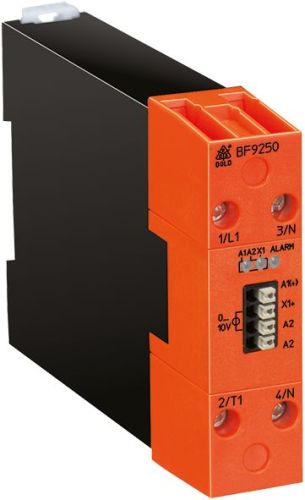
Dold 0066488 semiconductor contactor AC24-115V AC25A
| Lieske Part No. | 1001494 |
|---|---|
| Mfg Part No | 0066488 |
| EAN-Code | 4030641664886 |
| Manufacturer | Dold |
| Here only | 235,40 EUR
280,13 EUR incl. VAT
|
Further information for Dold 0066488 semiconductor contactor AC24-115V AC25A
| Technical data | |
| Analog Input Control | 4 - 20 mA |
| Approvals | UL |
| Load current up to | 50 A |
| Load voltage up to | AC 480 V |
| Number of poles | 1-pole |
| Width | 22,5 mm, 45 mm, 90 mm |
| Type | BF 9250/0_2 |
| Temperature monitoring | |
| Variant | |
| Auxiliary voltage | AC/DC 24 V |
| Contact equipping | without signal contact |
| Control input | DC 4 - 20 mA |
| Load current | AC 25 A |
| Load voltage | AC 24 - 115 V |
| Semiconductor output | 1-pole |
| Approvals and Markings | UL-listed C/US |
| Variant | Self optimising, to achieve as short as possible control periods, suitable for infrared lamps |
Applications
This semiconductor contactor is designed for use in industrial heating systems where precise and disturbance-free temperature control is required. It is particularly suitable for applications with infrared lamps, as the self-optimized pulse distribution ensures rapid and even energy delivery. The zero-voltage switching function minimizes switching disturbances and ensures noiseless switching of the load. The maximum rated voltage is AC 480 V, and the maximum rated current is AC 50 A, with the specified variant designed for 25 A.
Functions and Features in Detail
The device includes an LED display that visually indicates the operating status: a green LED indicates the supply voltage, a yellow LED indicates the output status, and a red LED indicates alarms. In case of synchronization errors, control input faults, or overheating of the power semiconductor, the LEDs light up accordingly. The overheating alarm is latching and requires a brief interruption of the supply voltage to reset. Temperature monitoring of the power semiconductor protects the device against overheating. A varistor protection safeguards against overvoltages.
Technology Explained Simply
Pulse packet control (Burst Firing) allows the load power to be controlled in small, controlled pulses, enabling precise temperature regulation. Zero-voltage switching ensures that the switch only turns on at voltage zero, minimizing network disturbances. Control is via an analog input (DC 4–20 mA), with the output power varying proportionally to the input signal. The resolution of the output control is 5 %, allowing fine adjustment of power. The maximum load voltage is AC 480 V, and the maximum load current is AC 50 A, with the specified variant designed for 25 A.
Compatibility and Accessories
The device is designed for loads with ohmic impedance and can be used in industrial heating systems. It is DIN rail mountable and has a width of 45 mm. The auxiliary voltage is AC/DC 24 V, with current consumption below 26 mA at DC 24 V. Control is via a DC 4–20 mA input, with other input types such as DC 0–10 V or potentiometer (0–10 kΩ) also possible. The actuation is reversible, enabling flexible integration into existing control systems.
Mounting and Installation
The device is snap-on mountable on DIN rail and can be installed in standard enclosures. Recommended clearances are 20 mm above and below and 10 mm to the left and right to ensure sufficient cooling. The operating temperature range is 0 to 40 °C, with current derating above 40 °C (0.4 A/°C for 25 A). The maximum ambient humidity is 75 % without condensation.
Operational Advantages
The semiconductor contactor provides fast, noiseless, and disturbance-free switching, ideal for sensitive heating systems. The LED indicators enable quick diagnosis of operating states and faults. Integrated temperature monitoring and varistor protection increase operational safety. The self-optimized pulse distribution ensures efficient energy transfer, especially with infrared lamps. DIN rail mounting and compact design facilitate integration into existing systems.

This is an offer of:
79279 Vörstetten
https://industry-electronics.com
Tel. 07666/88499-0
Fax. 07666/88499-111
Diesen Artikel finden Sie unter:
industry-electronics.com/artikel/1001494

Lieske Elektronik e.K.
Reutener Str. 1079279 Vörstetten
https://industry-electronics.com
Tel. 07666/88499-0
Fax. 07666/88499-111
Diesen Artikel finden Sie unter:
industry-electronics.com/artikel/1001494