
Dold 0066425 RN9877.11/61 3/N AC175-525/100-300V phase monitor 4-20%
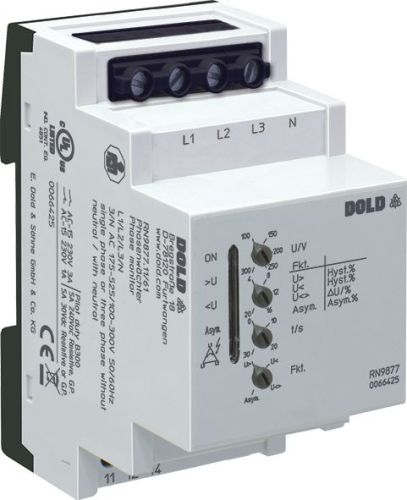
Dold 0066425 RN9877.11/61 3/N AC175-525/100-300V phase monitor 4-20%
| Lieske Part No. | 1151726 |
|---|---|
| Mfg Part No | 0066425 |
| EAN-Code | 4030641664251 |
| Manufacturer | Dold |
| Here only | 174,16 EUR
207,25 EUR incl. VAT
|
Further information for Dold 0066425 RN9877.11/61 3/N AC175-525/100-300V phase monitor 4-20%
| Technical data | |
| 1- / 3-phase | 1, 3 |
| Approvals | UL |
| Auxiliary voltage | Without |
| Enclosure design | Distribution board |
| Measuring range max. | 525 V |
| Output contacts | 1 C/O contact |
| Standard measuring range | 3/N AC 175 - 525 V / 100 - 300 V |
| Width | 52,5 mm |
| Type | RN 9877 |
| Variant | |
| Contact equipping | 1 changeover contact |
| Hysteresis | 4 - 20 % |
| Measuring voltage | 3/N AC 175 - 525 / 100 - 300 V |
| Switching delay | 0 - 30 s |
| Approvals and Markings | UL-listed C/US |
| Variant | De-energized on trip. With neutral. Voltage monitoring |
Applications
The phase monitor is suitable for monitoring rotating and alternating current networks with 50/60 Hz. It is particularly used in installations with motor loads to detect phase failures, overvoltages, undervoltages, voltage range exceedances, phase asymmetry, and incorrect phase sequence. Early fault detection enables preventive maintenance and protects motors and systems from damage. The functions can be selected via a function selector switch without complex menu structures.
Functions and Equipment in Detail
The device features an output with 1 changeover contact, which is de-energized in the event of a fault. The hysteresis is adjustable in the range of 4 to 20 %, enabling secure re-activation when returning to normal conditions. The switching delay can be set between 0 and 30 seconds to filter out short-term voltage fluctuations. The monitoring functions include detection of overvoltage, undervoltage, voltage range exceedance, phase asymmetry, missing neutral conductor, and incorrect phase sequence in 3-phase networks. Indication is provided via LEDs, which light up or flash depending on the fault condition.
Technology Explained Simply
Measurement is performed directly on phases L1, L2, L3 and the neutral conductor N. In 3-phase operation, all three phases are measured against N. The device is powered from the measured voltage of the phases, eliminating the need for an external auxiliary voltage. The functions are selected via a rotary selector switch, which activates the respective monitoring type (e.g. U>, U<, U<>, Asym.). The LED indicators signal the respective status, with a flashing LED indicating a fault that will trigger the relay after the switching delay has elapsed.
Compatibility and Accessories
The device is suitable for 3- and 1-phase systems and can be operated with or without a neutral conductor connection. It complies with the standard IEC/EN 60255-1 and is UL-listed C/US. It is used in installation distributors, with the width of 52.5 mm fitting standard switchboards.
Mounting and Installation
Mounting is carried out in an installation distributor. The connection terminals are clearly labeled: L1, L2, L3 for phase voltages, N for the neutral conductor, and 11, 12, 14 for the changeover contacts of the output relay. Wiring is simple, as no auxiliary voltage is required. Adjustments for hysteresis and switching delay are made via mechanical adjustment options on the device.
Advantages in Operation
Preventive maintenance through early fault detection prevents costly damage. High repeatability and a wide measurement voltage range increase reliability. Simple operation via a rotary selector switch reduces the risk of errors during commissioning. The operational safety and availability of the system are ensured by continuous monitoring of the network voltage.

This is an offer of:
79279 Vörstetten
https://industry-electronics.com
Tel. 07666/88499-0
Fax. 07666/88499-111
Diesen Artikel finden Sie unter:
industry-electronics.com/artikel/1151726

Lieske Elektronik e.K.
Reutener Str. 1079279 Vörstetten
https://industry-electronics.com
Tel. 07666/88499-0
Fax. 07666/88499-111
Diesen Artikel finden Sie unter:
industry-electronics.com/artikel/1151726