
Dold 0066044 HL3096N.60/400/61 DC24V coupling module with LED
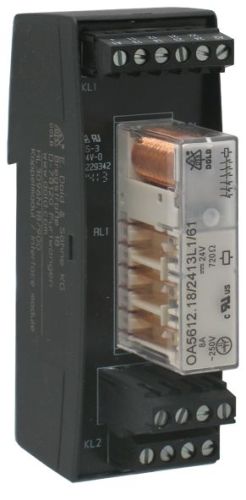
Dold 0066044 HL3096N.60/400/61 DC24V coupling module with LED
| Lieske Part No. | 1001768 |
|---|---|
| Mfg Part No | 0066044 |
| EAN-Code | 4030641660444 |
| Manufacturer | Dold |
| Here only | 71,39 EUR
84,95 EUR incl. VAT
|
Further information for Dold 0066044 HL3096N.60/400/61 DC24V coupling module with LED
| Technical data | |
| Approvals | UL |
| Connection | Cage clamp terminals, Screw terminals |
| Enclosure design | Switch cabinet |
| Output contacts max. | 2 NC contacts, 4 NO contacts |
| Thermal current Ith max. | 5 A |
| Width | 36 mm |
| Type | HL 3096N |
| Variant | |
| Contact equipping | 5 NO contacts, 1 NC contact |
| Nominal voltage | DC 24 V |
| Terminal type | screw terminal |
| Approvals and Markings | UL-listed C/US |
| Variant | With LED. Standard relay. Contact material AgNi |
Applications
This coupling module is intended for applications in industrial control and safety technology where signal multiplication or amplification is required. It is particularly suitable for coupling safety relays, as it allows the contact output to be safely monitored via forced-guided normally open contacts. Typical use cases include automation systems, machine controls, and installations with high safety requirements.
Functions and equipment in detail
The module features a contact configuration with five normally closed contacts (NO) and one normally open contact (NC), where the normally open contacts are forced-guided according to IEC 61810-3. This ensures reliable state monitoring, as a contact failure will inevitably cause the normally open contact to open. The connection terminals are screw-type terminals, with cable fixation achieved via cage spring terminals. The maximum connection cross-section is 0.5 to 2.5 mm² for both rigid and flexible conductors, which reduces thermal stress on the connection wires. The terminals are equipped with non-loosening terminal screws, to be tightened with a torque of 0.5 Nm.
Technology explained simply
The coupling module operates at a nominal voltage of DC 24 V and has a maximum thermal current Ith of 5 A. The operating voltage range is 0.8 to 1.1 times the nominal voltage. The input power is 0.8 W. The device includes a reverse polarity protection diode to prevent incorrect supply. Optionally, a freewheeling diode can be integrated between A1+ and A2, which is useful for inductive loads. The contact materials are made of AgNi, with a variant available featuring an additional gold plating of 0.2 μm Au. An LED indicator signals the relay's operating status.
Compatibility and accessories
The module is part of the SAFEMASTER series and can be combined with safety relays, particularly with the OA 5612, which is inserted into the socket HL 3096N. It is designed for use in combination with other modules from the HC 3096N and OA 5611 series, with the socket HL 3096N having a width of 36 mm. The devices comply with standards DIN EN 61810-1, IEC 60664-1, and IEC/EN 60947-5-1.
Mounting and installation
Mounting is done via DIN rail mounting according to DIN EN 60715. The module width is 36 mm, and the housing dimensions are 36 mm (width) × 106 mm (height) × 65 mm (depth). The housing is made of thermoplastic and is designed for use in enclosures. The housing protection rating is IP 40, and the terminals have an IP 20 rating. Vibration resistance is tested according to IEC/EN 60068-2-6 with an amplitude of 0.35 mm and a frequency of 10 to 55 Hz. Climate resistance corresponds to the damp heat test according to IEC/EN 60068-2-30.
Advantages in operation
The coupling module provides simple and reliable signal multiplication, reducing the number of required auxiliary contacts. The forced-guided normally open contacts enable secure state monitoring, which is particularly beneficial in safety-critical installations. The combination of low space requirement, high contact load capacity, and easy installation makes the module an efficient solution for industrial control systems. The EMC properties, including protection against electrostatic discharge (8 kV), high-frequency radiation (20 V/m up to 1 GHz), and fast transients (4 kV), ensure robust performance in industrial environments. Radio frequency interference suppression complies with Class B limits according to EN 55011.

This is an offer of:
79279 Vörstetten
https://industry-electronics.com
Tel. 07666/88499-0
Fax. 07666/88499-111
Diesen Artikel finden Sie unter:
industry-electronics.com/artikel/1001768

Lieske Elektronik e.K.
Reutener Str. 1079279 Vörstetten
https://industry-electronics.com
Tel. 07666/88499-0
Fax. 07666/88499-111
Diesen Artikel finden Sie unter:
industry-electronics.com/artikel/1001768