
Dold 0066017 ND5017/024 residual current transformer
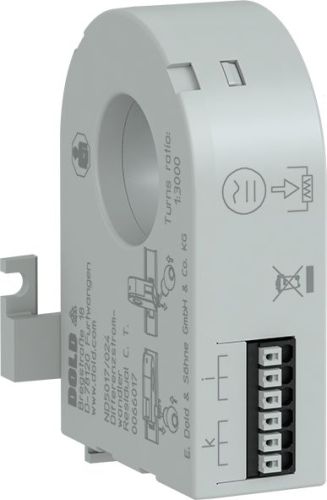
Dold 0066017 ND5017/024 residual current transformer
| Lieske Part No. | 1000865 |
|---|---|
| Mfg Part No | 0066017 |
| EAN-Code | 4030641660178 |
| Manufacturer | Dold |
| Here only | 172,90 EUR
205,75 EUR incl. VAT
|
Further information for Dold 0066017 ND5017/024 residual current transformer
| Technical data | |
| Diameter | 24 mm, 70 mm |
| For relay type | RR 5887 |
| Type | ND 5017 |
| Variant | |
| Variant | 24 mm inner diameter |
Applications
The differential current transformer ND5017/024 is used in industrial plants, shipbuilding, plant engineering, and photovoltaic installations. It is suitable for monitoring IT systems where insulation integrity is of critical importance. The application is carried out in conjunction with the test current generator RR 5886 and the insulation fault detection device RR 5887, which together enable precise fault localisation. The systems are certified according to DIN EN 61557-9 (VDE 0413-9):2009 and DIN EN 61557-1 (VDE 0413-1), ensuring the reliability of measurements and compliance with electrical safety standards.
Functions and Equipment in Detail
The current transformer operates independently of other external current transformers and is directly connected to the measurement channels of the insulation fault detection device RR 5887. Calibration is performed automatically by the RR 5887 device, ensuring high measurement accuracy and repeatability of results. Measurement results are displayed via LEDs: a yellow LED indicates a warning for insulation fault currents exceeding 1 mA, while a red LED signals an alarm for fault currents exceeding 5 mA. The display is channel-specific, enabling precise fault localisation.
Technology Explained Simply
The differential current transformer measures the difference between incoming and outgoing current in a conductor. In an intact insulation, this difference is zero. When an insulation fault occurs, part of the current flows through the insulation to ground, detected as a differential current. This value is evaluated and visualised by the insulation fault detection device RR 5887. The technology allows precise fault localisation without interrupting plant operation. Mounting on a DIN rail enables flexible and standardised installation in enclosures.
Compatibility and Accessories
The differential current transformer ND5017/024 is specifically designed for use with the insulation fault detection device RR 5887. It is part of a system that can support up to four or eight current transformers, depending on the configuration of the RR 5887 device. Communication between devices occurs via an RS-485 bus connection, enabling synchronisation of test current evaluation. Optionally, the bus connection can also be used for Modbus RTU fieldbus integration, allowing integration into higher-level control systems.
Mounting and Installation
Mounting is performed on a DIN rail, with both horizontal and vertical orientations possible. Fixing is done via screws or directly onto the DIN rail, depending on requirements. The connection terminals are clearly labelled, enabling simple and error-free installation. The width is 105 mm, allowing placement in standard enclosures. The current transformers are designed for industrial environments and meet the requirements for insulation coordination according to IEC 60664-1.
Operational Advantages
Early detection and localisation of insulation faults enable quick and targeted repairs, minimising downtime. Simple operation through automatic calibration and clear adjustment elements reduces the risk of errors during commissioning. Status output via an external switching output allows integration into higher-level alarm and control systems. Storage characteristics can be adjusted via a bridge between terminals X1 and X2, enabling adaptation to specific requirements. Combining multiple insulation fault detection devices via the RS-485 bus increases the number of measurement channels and enables more precise fault localisation in extensive networks.

This is an offer of:
79279 Vörstetten
https://industry-electronics.com
Tel. 07666/88499-0
Fax. 07666/88499-111
Diesen Artikel finden Sie unter:
industry-electronics.com/artikel/1000865

Lieske Elektronik e.K.
Reutener Str. 1079279 Vörstetten
https://industry-electronics.com
Tel. 07666/88499-0
Fax. 07666/88499-111
Diesen Artikel finden Sie unter:
industry-electronics.com/artikel/1000865