
Dold 0065134 time relay delayed pickup DC24V 0.5-10S
Industrial Material > Industrial relays and contactors > Industrial Timers
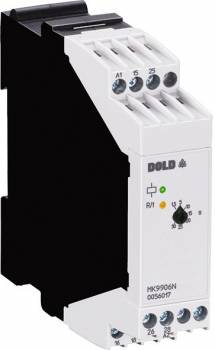
Dold 0065134 time relay delayed pickup DC24V 0.5-10S
| Lieske Part No. | 1331502 |
|---|---|
| Mfg Part No | 0065134 |
| EAN-Code | 4030641651343 |
| Manufacturer | Dold |
| Here only | 117,47 EUR
139,79 EUR incl. VAT
|
Further information for Dold 0065134 time relay delayed pickup DC24V 0.5-10S
| Technical data | |
| Enclosure design | Switch cabinet |
| Output contacts | 2 C/O contacts |
| Time function(s) | On-delay |
| Width | 22,5 mm |
| Type | MK 9906N/600 |
| Variant | |
| Contact equipping | 2 changeover contacts |
| Nominal voltage | DC 24 V |
| Terminal type | plug in cage clamp terminal |
| Time range | 0,5 - 10 s |
| Approvals and Markings | UKCA |
Applications
This time relay is intended for applications in industrial environments where precise timing control is required. Typical uses include controlling drives, pumps, fans, or other electrical loads where immediate switching is not desired or technically inappropriate. The delayed-on function ensures that the output is activated only after the set delay time has elapsed, once the input voltage is applied.
Functions and Features in Detail
The device features two changeover contacts as output contacts, suitable for switching loads. The contact configuration allows control of two independent circuits. The delay time is adjusted via a continuous rotary switch on an absolute scale, ensuring precise and repeatable settings. The repeatability accuracy is ≤ ± 0.5 % of the scale end value, ensuring high precision in time control. Two LED indicators signal the operating status: the upper LED lights up when operating voltage is present, and the lower LED indicates when the output relay is activated (contacts 15–18 closed).
Technology Explained Simply
The time relay operates according to standard EN 61812-1 and is designed for continuous operation. The rated voltage is DC 24 V, with an operating voltage range between 0.9 and 1.25 times the rated voltage. The drop-out voltage is 15 % of the rated voltage. The input voltage is supplied via terminals A1 (L/+) and A2 (N/-). The output contacts are configured as changeover contacts, with contacts 15–16 and 25–26 each forming a changeover contact. The contact material consists of AgSnO₂, ensuring good switching performance and long service life. The electrical life is at least 500,000 switching cycles at 3 A and AC 230 V, and the mechanical life exceeds 30 million switching cycles. The drop-out time is 30 ms, and the reset time is 40 ms.
Compatibility and Accessories
The device is equipped with spring-loaded terminals, enabling quick and secure connection of wires. The terminals are designed for connecting 2 x 1.5 mm² stranded wire with ferrules and plastic sleeves or 2 x 2.5 mm² solid wire according to DIN 46228-1/-2/-3/-4. Control is achieved via two-wire initiators, facilitating integration into existing control systems. The device is designed for use in enclosures and complies with protection rating IP 40 for the housing and IP 20 for the terminals. The operating temperature range is -20 °C to +60 °C, and the storage temperature range is -25 °C to +65 °C.
Mounting and Installation
The time relay is mounted in standard control panels with a width of 22.5 mm. Installation is done by inserting the device into an enclosure front, with terminals provided for wire connections. The delay time is adjusted using the rotary switch on the front of the device. The LED indicators allow for visual inspection of the operating status. The terminals are clearly labeled (A1, A2, 15–18, 25–26), simplifying installation and maintenance.
Operational Advantages
The high repeatability accuracy and continuous adjustment of the delay time ensure reliable and precise control. The use of spring-loaded terminals enables quick and secure wire connections. The integrated LED indicators facilitate diagnosis and maintenance. The device is designed for continuous operation and features high mechanical and electrical life, enhancing operational reliability. Compatibility with two-wire initiators and compliance with standard EN 61812-1 ensure safe and standardized integration into industrial control systems.

This is an offer of:
79279 Vörstetten
https://industry-electronics.com
Tel. 07666/88499-0
Fax. 07666/88499-111
Diesen Artikel finden Sie unter:
industry-electronics.com/artikel/1331502

Lieske Elektronik e.K.
Reutener Str. 1079279 Vörstetten
https://industry-electronics.com
Tel. 07666/88499-0
Fax. 07666/88499-111
Diesen Artikel finden Sie unter:
industry-electronics.com/artikel/1331502