
Dold 0065106 time relay delayed pickup DC24V 0.5-10S
Industrial Material > Industrial relays and contactors > Industrial Timers
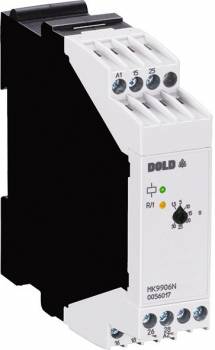
Dold 0065106 time relay delayed pickup DC24V 0.5-10S
| Lieske Part No. | 1331503 |
|---|---|
| Mfg Part No | 0065106 |
| EAN-Code | 4030641651060 |
| Manufacturer | Dold |
| Here only | 103,19 EUR
122,80 EUR incl. VAT
|
Further information for Dold 0065106 time relay delayed pickup DC24V 0.5-10S
| Technical data | |
| Enclosure design | Switch cabinet |
| Output contacts | 2 C/O contacts |
| Time function(s) | On-delay |
| Width | 22,5 mm |
| Type | MK 9906N/600 |
| Variant | |
| Contact equipping | 2 changeover contacts |
| Nominal voltage | DC 24 V |
| Terminal type | screw terminals fixed |
| Time range | 0,5 - 10 s |
| Approvals and Markings | UKCA |
Applications
The time relay is used in industrial automation technology where time-controlled processes are required. Typical applications include the control of drives, pumps, lighting systems, or safety functions, where a defined delay between triggering a signal and the output response is necessary. The delayed activation allows the device to be activated only after the set time has elapsed, which is useful for synchronizing processes or avoiding short-term disturbances.
Functions and Equipment in Detail
The device features 2 changeover contacts as output contacts, suitable for controlling loads. The contacts are made of AgSnO₂, a material designed for high switching life and low contact resistance. The width is 22.5 mm, making it suitable for standard control panels. The terminal type consists of fixed screw terminals, designed for connecting solid conductors up to 2.5 mm² or stranded conductors up to 1.5 mm² with ferrules and plastic sleeves. The rated voltage is DC 24 V, and the device can be operated within a voltage range of 0.9 to 1.25 times the rated voltage.
Technology Explained Simply
The time function is delayed-activation, meaning the output is only activated after the set time has elapsed once the input signal is applied. Adjustment is made via a rotary control on an absolute scale, enabling exact repeatability of the delay time. The repeatability accuracy is ≤ ± 0.5 % of the scale end value, ensuring high precision in repeated switching operations. The reset time is 30 ms, indicating the speed at which the contact returns after the input signal is switched off. The recovery time at 50/100 % of the set time is 40 ms, indicating the time until the device is ready for operation again after a switching cycle.
Compatibility and Accessories
The time relay can be actuated by two-wire initiators, simplifying integration into existing control systems. It is designed for use in enclosures and complies with the standard EN 61812-1. The approvals include the UKCA mark. Optional plug-in terminal blocks are available, enabling quick device replacement. The insulation test is performed at 2.5 kV/1 min, and the overvoltage category is III. EMC compatibility is ensured according to IEC/EN 61000-4-2 to -4-6, including protection against electrostatic discharge (8 kV) and fast transients (4 kV).
Mounting and Installation
The device is mounted in enclosures and requires installation within a temperature range of -20 °C to +60 °C. Storage is permitted at -25 °C to +65 °C. The relative humidity may reach up to 93 % at 40 °C. The operating altitude is limited to ≤ 2000 m. The housing design is intended for enclosure mounting, and the protection rating of the housing is IP 40, while the terminals have IP 20. Mounting is done via the designated mounting points in the enclosure.
Advantages in Operation
The time relay offers high accuracy and repeatability of the delay time, which is crucial for precise control tasks. The continuous adjustment via an absolute scale allows flexible adaptation to different requirements. The integrated LED indicators signal operational readiness (upper LED) and output activation (lower LED), facilitating diagnostics during operation. The mechanical life exceeds 30 million switching cycles, ensuring high reliability even with frequent use. The electrical life is at least 500,000 switching cycles at 3 A/AC 230 V, highlighting its suitability for industrial applications.

This is an offer of:
79279 Vörstetten
https://industry-electronics.com
Tel. 07666/88499-0
Fax. 07666/88499-111
Diesen Artikel finden Sie unter:
industry-electronics.com/artikel/1331503

Lieske Elektronik e.K.
Reutener Str. 1079279 Vörstetten
https://industry-electronics.com
Tel. 07666/88499-0
Fax. 07666/88499-111
Diesen Artikel finden Sie unter:
industry-electronics.com/artikel/1331503