
Dold 0064886 semiconductor contactor AC48-480V AC20A
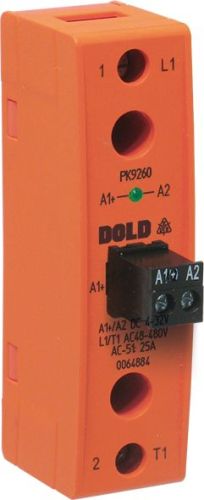
Dold 0064886 semiconductor contactor AC48-480V AC20A
| Lieske Part No. | 1001602 |
|---|---|
| Mfg Part No | 0064886 |
| EAN-Code | 4030641648862 |
| Manufacturer | Dold |
| Here only | 61,75 EUR
73,48 EUR incl. VAT
|
Further information for Dold 0064886 semiconductor contactor AC48-480V AC20A
| Technical data | |
| Approvals | UL, UL-Recognized |
| Load current up to | 88 A |
| Load voltage up to | AC 600 V |
| Number of poles | 1-pole |
| On/Off Input Control | AC, AC/DC, DC |
| Width | 22,5 mm |
| Type | PK 9260 |
| Variant | |
| Control voltage | DC 4 - 32 V |
| Load current | AC 20 A |
| Load voltage | AC 48 - 480 V |
| Semiconductor output | 1-pole |
| Approvals and Markings | UL-listed C/US |
| Variant | Switching at zero crossing. M4 flat terminal. With heat sink |
Applications
This semiconductor relay is suitable for use in machines and plants in the plastics and rubber industry, such as injection moulding machines, as well as in packaging machines, soldering systems, and machines in the food industry. It is designed for frequent, wear-free, and noiseless switching, making it advantageous for use in plants with high operating cycles. The zero-voltage switching is particularly suitable for resistive loads, as it minimizes current and voltage peaks, thereby increasing the service life of both the load and the relay.
Functions and equipment in detail
The device features two antiparallel-connected thyristors responsible for the switching function. The DCB technology (Direct-Copper-Bonding process) ensures excellent heat transfer, reducing thermal stress and increasing reliability. The connection type is implemented as an M4 flat terminal, enabling a secure and quick connection. The width is 22.5 mm, minimizing space requirements in the enclosure. The relay is equipped with a heatsink that can be snap-mounted onto a DIN rail to ensure efficient heat dissipation.
Technology explained simply
Zero-voltage switching means that the relay does not switch abruptly, but at the next zero crossing of voltage or current. This avoids sparking and network interference, which is especially important for resistive loads. The control voltage range of DC 4–32 V allows flexible control via digital controllers. The LED indicator shows the status of the control input, enabling visual monitoring of operation. The peak blocking voltage is up to 1600 V, and the insulation voltage is 4000 V, ensuring high electrical safety.
Compatibility and accessories
The semiconductor relay complies with IEC/EN 62314 as well as IEC/EN 60947-4-2 and -4-3. It is rated for load currents up to 88 A (AC-51), with the specified variant having a load current of AC 20 A at load voltages of AC 48–480 V. The load voltage can reach up to AC 600 V. Control is possible via AC, AC/DC, or DC, with the specified variant using DC 4–32 V. Certifications include UL-listed C/US and UL-Recognized, enabling use in specific markets.
Mounting and installation
The device can be mounted onto existing cooling surfaces using two screws. Alternatively, it is equipped with a heatsink that can be snap-mounted onto a DIN rail. When mounting multiple relays side by side, sufficient cooling and ventilation must be ensured to avoid overheating. Mounting requires no additional tools, as the terminals can be connected directly.
Advantages in operation
The semiconductor relay offers high switching frequency and long service life due to its wear-free switching principle. It operates noiselessly and is resistant to vibrations and mechanical shocks. The compact design with only 22.5 mm width enables space-saving installation. Heat dissipation via the heatsink and DCB technology ensures reliable operational safety, even under high loads. The LED indicator simplifies diagnosis and maintenance, as the operating status is directly visible.

This is an offer of:
79279 Vörstetten
https://industry-electronics.com
Tel. 07666/88499-0
Fax. 07666/88499-111
Diesen Artikel finden Sie unter:
industry-electronics.com/artikel/1001602

Lieske Elektronik e.K.
Reutener Str. 1079279 Vörstetten
https://industry-electronics.com
Tel. 07666/88499-0
Fax. 07666/88499-111
Diesen Artikel finden Sie unter:
industry-electronics.com/artikel/1001602