
Dold 0064795 GB9034 400A AC50/60Hz 230V motor brake unit
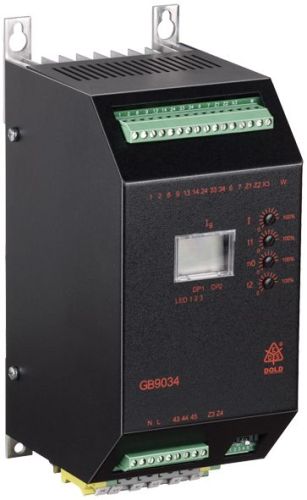
Dold 0064795 GB9034 400A AC50/60Hz 230V motor brake unit
| Lieske Part No. | 1001878 |
|---|---|
| Mfg Part No | 0064795 |
| EAN-Code | 4030641647957 |
| Manufacturer | Dold |
| Here only | 4.376,27 EUR
5.207,76 EUR incl. VAT
|
Further information for Dold 0064795 GB9034 400A AC50/60Hz 230V motor brake unit
| Technical data | |
| Braking current adjustable up to max. | 600 A |
| Braking time adjustable up to max. | 320 s |
| Width | 110 mm |
| Type | GB 9034 |
| Automatic standstill monitoring | |
| External brake contactor required | |
| Signalling output | |
| Temperature monitoring | |
| Variant | |
| Auxiliary voltage | Without |
| Braking current | 400 A |
| Nominal voltage | AC 230 V |
| Approvals and Markings | UKCA |
Applications
The motor brake device is designed for industrial applications, particularly in areas such as sawmills, centrifuges, woodworking machines, textile machines, and conveyor systems. It is used to reduce motor coast-down time, thereby increasing safety and improving cost-efficiency through shorter downtime. The device is applied in systems requiring reliable and precise braking functions, for example in production lines or machines with high safety requirements.
Functions and Equipment in Detail
The device features automatic standstill monitoring, ensuring the motor stops within the set braking time. If standstill is not achieved, a fault signal is triggered via a potential-free alarm contact. Additionally, temperature monitoring is integrated to monitor the motor or cooling body condition. The braking function is activated via an external brake contactor, controlled through terminals 1/2. The supply voltage is connected to terminals L1-L2, with the interlock contact closing for the motor contactor. The ready LED indicates that the supply voltage is present.
Technology Explained Simply
Braking is achieved by feeding DC current into the stator winding of the motor, generating a magnetic field that slows the motor. The DC voltage is generated via a single-phase rectifier, which converts the AC voltage from the mains supply into DC voltage. The timing of the brake contactor is coordinated to ensure a safety time interval between switching off the motor contactor and switching on the brake contactor. This prevents short-term induction voltages from damaging the power section. The braking time and braking current are adjustable via device parameters, allowing adaptation to different motor requirements.
Compatibility and Accessories
The device is suitable for all asynchronous motors and complies with the standard IEC/EN 60947-4-2. It is equipped with an alarm output that enables signaling in case of malfunction or failure to reach standstill. Certifications include the UKCA mark. Control is via terminals 1/2, ensuring the safety time interval between motor contactor de-energization and brake contactor energization.
Mounting and Installation
Mounting is done in an enclosure, taking into account the width of 110 mm. The supply voltage is connected to L1-L2, and the motor to U, V, W. Terminals 6-7 serve as starter contact (normally open contact of the motor contactor), while terminals 8-9 handle the interlock for the motor contactor. The external brake contactor is controlled via 1-2. The connection terminals are clearly labeled, with functions such as brake interruption, 2nd braking time, motor PTC (optional), and fault signaling (33/34) defined. The LED indicators show the operating status, with LED 1 indicating readiness, LED 2 indicating the current setpoint, and LED 3 indicating the actual current value.
Advantages in Operation
The device offers wear-free and maintenance-free operation, increasing service life and reducing maintenance costs. The shorter coast-down time improves safety and productivity. Easy integration into existing systems enables quick conversion without extensive modifications. The adjustable parameters for braking current and time allow customized adaptation to specific motor applications. The integrated standstill and temperature monitoring increase reliability and enable early fault detection.

This is an offer of:
79279 Vörstetten
https://industry-electronics.com
Tel. 07666/88499-0
Fax. 07666/88499-111
Diesen Artikel finden Sie unter:
industry-electronics.com/artikel/1001878

Lieske Elektronik e.K.
Reutener Str. 1079279 Vörstetten
https://industry-electronics.com
Tel. 07666/88499-0
Fax. 07666/88499-111
Diesen Artikel finden Sie unter:
industry-electronics.com/artikel/1001878