
Dold 0064656 reversing contactor BH9253.11/61 AC220-240V 20A
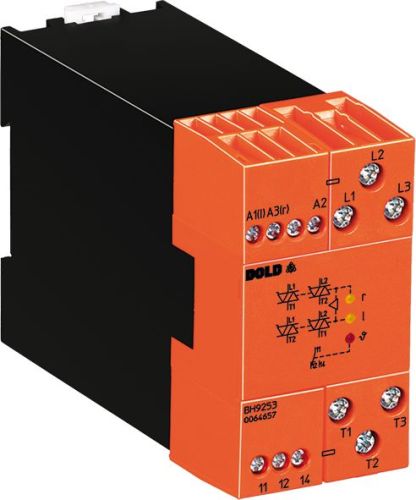
Dold 0064656 reversing contactor BH9253.11/61 AC220-240V 20A
| Lieske Part No. | 1002391 |
|---|---|
| Mfg Part No | 0064656 |
| EAN-Code | 4030641646561 |
| Manufacturer | Dold |
| Here only | 484,33 EUR
576,35 EUR incl. VAT
|
Further information for Dold 0064656 reversing contactor BH9253.11/61 AC220-240V 20A
| Technical data | |
| Approvals | UL |
| Enclosure design | Switch cabinet |
| Load current up to | 20 A |
| Load voltage up to | 3AC 24 - 480 V |
| Number of poles | 3-pole |
| On/Off Input Control | AC, AC/DC |
| Width | 45 mm, 67,5 mm, 112,5 mm |
| Type | BH 9253 |
| Signalling output | |
| Temperature monitoring | |
| Variant | |
| Contact equipping | 1 changeover contact |
| Nominal voltage | AC 220 - 240 V |
| Rated continuous current | 20 A |
| Switchover delay | 100 ms |
| Approvals and Markings | UL-listed C/US |
Applications
This reversing contactor is designed for use in industrial electrical installations, particularly for controlling 3-phase asynchronous motors with a maximum power of 5.5 kW at 400 V (or 7.5 HP at 460 V). It is suitable for installations where mechanical interlocking is insufficient and electrical interlocking of both rotation directions is required to prevent simultaneous activation. The galvanic isolation between control and main current circuits increases operational safety.
Functions and Equipment in Detail
The device features electrical interlocking, ensuring that both rotation directions cannot be activated simultaneously. In case of overtemperature of the power semiconductors, the device automatically switches off to prevent damage. An output relay and a red LED are activated to indicate the fault condition. This condition is stored; after cooling down, the device can be reactivated by briefly switching off and then switching on the control voltage again. Status indication is provided by LEDs: a yellow LED lights up for left rotation, another yellow LED for right rotation, and the red LED for overtemperature.
Technology Explained Simply
The reversing contactor operates with zero-voltage switching, meaning the switching process occurs at the zero crossing of the voltage wave to minimize current surges and sparking. Control is via AC or AC/DC, with the control voltage required to come from the same phase of the network. The 100 ms switching pause ensures that phases are safely switched without causing short circuits. Temperature monitoring protects the power semiconductors from overheating, which is especially important during frequent switching operations.
Compatibility and Accessories
The device complies with IEC/EN 60947-1 and IEC/EN 60947-4-2 standards and carries UL certification C/US. It is designed for load voltages up to 3AC 24–480 V and load currents up to 20 A. The width varies depending on model variant: 45 mm, 67.5 mm, or 112.5 mm. The connection terminals are rated for max. 10 mm² (solid) or 6 mm² (stranded) for load connection, and 2.5 mm² (solid) or 1.5 mm² (stranded) for control connection. Mounting is on DIN rail according to IEC/EN 60715.
Mounting and Installation
Installation is carried out in an enclosure on DIN rail. The connection terminals are equipped with M3,5 screws, to be tightened with a torque of 1.2 Nm (load connection) or 0.8 Nm (control connection). Terminal marking follows EN 50005. The control voltage must come from the same phase of the network to ensure correct operation.
Operational Advantages
The reversing contactor provides reliable and safe switching of motor rotation direction with low switching delay. The integrated temperature monitoring and alarm output relay increase operational safety. LED indicators allow for quick visual diagnosis of the operating status. Galvanic isolation between control and main current circuits protects control electronics from interference. The device is designed for operating temperatures from -20 °C to +60 °C and can be used up to an altitude of 2000 m above sea level.

This is an offer of:
79279 Vörstetten
https://industry-electronics.com
Tel. 07666/88499-0
Fax. 07666/88499-111
Diesen Artikel finden Sie unter:
industry-electronics.com/artikel/1002391

Lieske Elektronik e.K.
Reutener Str. 1079279 Vörstetten
https://industry-electronics.com
Tel. 07666/88499-0
Fax. 07666/88499-111
Diesen Artikel finden Sie unter:
industry-electronics.com/artikel/1002391