
Dold 0064251 speed-stop monitor BH5932.22/111/61 ACDC24V
Industrial Material > Industrial relays and contactors > Switching units / measuring, control relay
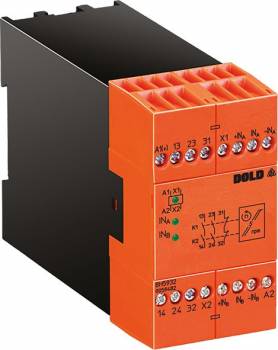
Dold 0064251 speed-stop monitor BH5932.22/111/61 ACDC24V
| Lieske Part No. | 1321051 |
|---|---|
| Mfg Part No | 0064251 |
| EAN-Code | 4030641642518 |
| Manufacturer | Dold |
| Here only | 525,55 EUR
625,40 EUR incl. VAT
|
Further information for Dold 0064251 speed-stop monitor BH5932.22/111/61 ACDC24V
| Technical data | |
| 1- / 2-channel | 2 |
| Approvals | UL |
| Cat. / PL acc. to EN ISO 13849-1 | 3/e |
| Classification | For initiators |
| Forcibly guided output contacts max. | 1 NC contact, 2 NO contacts |
| SIL CL acc. to IEC/EN 62061 | 3 |
| SIL acc. to IEC/EN 62061 | 3 |
| Thermal current Ith max. | 4 A |
| Width | 45 mm |
| Type | BH 5932 |
| Variant | |
| Contact equipping | 2 NO contacts, 1 NC contact |
| Nominal voltage | AC/DC 24 V |
| Response value | 7 - 21000 IPM |
| Approvals and Markings | UL-listed C/US, TÜV, CCC |
| Variant | With sensor detection. PNP-input. Adjustable setting value channel 1 and 2 together adjustable |
Applications
The BH5932 is suitable for monitoring drives in various industrial environments, particularly in machines with moving parts such as presses, milling machines, conveyor systems, or packaging machines. It is applied in safety-critical processes where unexpected standstill or uncontrolled movement could lead to damage or injuries. Its classification as an initiator monitoring switch makes it especially suitable for systems requiring high safety integrity.
Functions and Equipment in Detail
The device features a 2-channel design, with both channels being adjustable together. The setpoint range is from 7 to 21000 IPM (impulses per minute), allowing flexible adaptation to different speeds. The inputs are designed for PNP proximity switches, with a variant available that includes initiator connection detection. This ensures that the connection to the sensor is monitored and any faulty connection is detected. The output contacts are fail-safe, consisting of 2 normally closed contacts and 1 normally open contact, enabling secure signal transmission even in case of mechanical faults.
Technology Explained Simply
The speed monitor operates at a rated voltage of AC/DC 24 V and is designed for use in industrial control systems. The fail-safe contacts ensure that the switching position is mechanically secured and cannot be altered by internal faults. The thermal current rating is up to 4 A, enabling use in high-power applications. The width of 45 mm allows for compact mounting in standard enclosures. Connection options include wires with 2 x 1.5 mm² or 2 x 2.5 mm² cross-sections, connected via sleeve and plastic ferrule according to DIN 46 228-1/-2/-3/-4.
Compatibility and Accessories
The BH5932 is compatible with inductive proximity switches from the NA 5001, NA 5002, NA 5005, and NA 5010 series. These sensors are designed as initiator sensors and can be operated with either PNP or NPN outputs depending on the model. The connection configuration is detailed in the datasheet, with wiring to inputs In A and In B. The sensors feature a protection rating of IP67, making them suitable for outdoor or damp environments. The switching frequency of the sensors ranges from 200 Hz to 5000 Hz depending on the model, and switching distances range from 1.5 mm to 10 mm.
Mounting and Installation
Mounting is done in standard enclosures with a width of 45 mm. The terminal connections are designed for wires with cross-sections up to 2.5 mm², with the use of sleeve and plastic ferrule according to DIN 46 228-1/-2/-3/-4 recommended. Sensor wiring is connected to inputs In A and In B, with exact assignment varying depending on the sensor model. The feedback circuits X1–X2 enable monitoring of external contacts, facilitating integration into existing safety circuits.
Operational Advantages
The BH5932 offers high safety integrity with Category 3 and Performance Level e according to EN ISO 13849-1, as well as SIL 3 according to IEC/EN 62061. The initiator connection detection ensures that faulty sensor connections are detected, increasing system reliability. The fail-safe contacts prevent unintended switching operations and ensure secure signal transmission. The adjustable setpoint function allows flexible adaptation to different drive conditions. Certifications including UL-listed C/US, TÜV, and CCC confirm compliance with international safety standards.
Certifications and Safety Standards
The device complies with safety standards EN ISO 13849-1 (Category 3, PL e) and IEC/EN 62061 (SIL 3). Certifications UL-listed C/US, TÜV, and CCC confirm compliance with respective national and international requirements. Its classification as an initiator monitoring switch makes it suitable for use in safety-critical installations. The IP67 protection rating of the sensors enables use in damp or dusty environments.
Compatibility with Sensors
The sensors NA 5001, NA 5002, NA 5005, and NA 5010 are compatible with the BH5932. Switching distances vary by model between 1.5 mm and 10 mm, and switching frequencies range from 200 Hz to 5000 Hz. The sensors are equipped with IP67 protection, making them suitable for outdoor use. The sensor cables have a length of 2 m, and the ambient temperature range is -25 to 70 °C. The sensors feature LED indicators for switching status.
Safety Functions
The initiator connection detection monitors the connection to the sensor and detects faulty connections. The fail-safe contacts ensure a mechanically secured switching position. The feedback circuits X1–X2 enable monitoring of external contacts. The adjustable setpoint function allows flexible adaptation to the respective drive condition. Safety categories Category 3, PL e, and SIL 3 guarantee high safety integrity.
Practical Application
In practice, the BH5932 is used in machines where safe shutdown is required in case of standstill or unauthorized movement. Use with inductive proximity switches enables precise motion monitoring. The fail-safe contacts and initiator connection detection increase system reliability. The certifications and safety standards ensure compliance with applicable regulations.

This is an offer of:
79279 Vörstetten
https://industry-electronics.com
Tel. 07666/88499-0
Fax. 07666/88499-111
Diesen Artikel finden Sie unter:
industry-electronics.com/artikel/1321051

Lieske Elektronik e.K.
Reutener Str. 1079279 Vörstetten
https://industry-electronics.com
Tel. 07666/88499-0
Fax. 07666/88499-111
Diesen Artikel finden Sie unter:
industry-electronics.com/artikel/1321051