
Dold 0063397 BG5933.22/61 DC24V two-hand safety relay
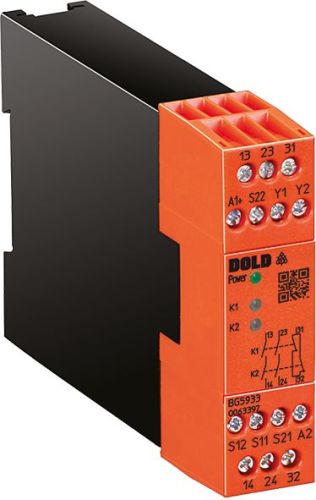
Dold 0063397 BG5933.22/61 DC24V two-hand safety relay
| Lieske Part No. | 1002447 |
|---|---|
| Mfg Part No | 0063397 |
| EAN-Code | 4030641633974 |
| Manufacturer | Dold |
| Here only | 302,79 EUR
360,32 EUR incl. VAT
|
Further information for Dold 0063397 BG5933.22/61 DC24V two-hand safety relay
| Technical data | |
| Approvals | UL |
| Cat. / PL acc. to EN ISO 13849-1 | 4/e |
| Connection | Pluggable screw terminals |
| Output contacts max. | 1 NC contact, 2 NO contacts |
| SIL CL acc. to IEC/EN 62061 | 3 |
| SIL acc. to IEC/EN 62061 | 3 |
| Safety integrity level according to EN 574 | lll C |
| Safety integrity level according to EN ISO 13851 | lll C |
| Thermal current Ith max. | 5 A |
| Width | 22,5 mm |
| Type | BG 5933 |
| Variant | |
| Contact equipping | 2 NO contacts, 1 NC contact |
| Nominal voltage | DC 24 V |
| Approvals and Markings | UL-listed C/US, TÜV, UKCA |
Applications
This safety relay is used in systems where two-handed operation is required to minimize the risk of accidents. Typical applications include presses, cutting machines, or other tools where uncontrolled movement must be prevented. Compliance with safety standards such as EN ISO 13849-1 and IEC/EN 62061 is ensured by the device’s certifications and markings. It is particularly suitable for applications seeking a cost-efficient alternative to conventional contactor control systems without compromising safety requirements.
Functions and Equipment in Detail
The device features a contact configuration with 2 NO contacts and 1 NC contact, designed for controlling safety functions. The rated voltage is DC 24 V, making it suitable for standard industrial applications. Connection is made via removable screw terminals, enabling flexible and secure connections. The maximum thermal current rating is 5 A, defining the contact load capacity. The device design allows monitoring of external contactors via a feedback circuit (Y1 – Y2), supporting contact multiplication and amplification.
Technology Explained Simply
The safety relay operates on the principle of two-handed operation: both switches must be actuated simultaneously to release the safety circuit. This prevents the user from performing a hazardous movement with one hand while the other hand is near the danger zone. The integrated monitoring function ensures the circuit is only activated when both inputs are correctly actuated. Certifications UL-listed C/US, TÜV, and UKCA confirm compliance with international safety standards. Safety levels Type III C according to EN ISO 13851 and Category 4 / Performance Level e according to EN ISO 13849-1 guarantee high reliability in operation.
Compatibility and Accessories
The relay is designed for use with two-hand switches, typically installed in presses and other machines with hazardous movements. It can be integrated into existing safety architectures, especially when contact amplification via the feedback circuit Y1 – Y2 is required. The connection terminals are rated for wires up to 2.5 mm², with the option to use sleeves and plastic collars according to DIN 46228-1/-2/-3/-4. The module width of 22.5 mm allows for compact mounting in standard control panels.
Mounting and Installation
Mounting is performed in standard control panels with a module width of 22.5 mm. The removable screw terminals facilitate installation and maintenance. The terminals are designed to ensure a secure and durable connection. Installation should follow the technical data and instructions described in the datasheet. Device indicators provide visual monitoring of the operating status, with specific indicators detailed in the datasheet.
Advantages in Operation
Thanks to its compact design and integrated safety function, it offers a cost-efficient solution for safety control. The use of removable screw terminals simplifies maintenance and replacement. The certifications and safety levels ensure high reliability, which is essential for use in hazardous working environments. The ability to monitor external contactors expands functionality and reduces the need for additional control components.

This is an offer of:
79279 Vörstetten
https://industry-electronics.com
Tel. 07666/88499-0
Fax. 07666/88499-111
Diesen Artikel finden Sie unter:
industry-electronics.com/artikel/1002447

Lieske Elektronik e.K.
Reutener Str. 1079279 Vörstetten
https://industry-electronics.com
Tel. 07666/88499-0
Fax. 07666/88499-111
Diesen Artikel finden Sie unter:
industry-electronics.com/artikel/1002447