
Dold 0063278 LG5925.48/900/61 DC24V light barrier control device
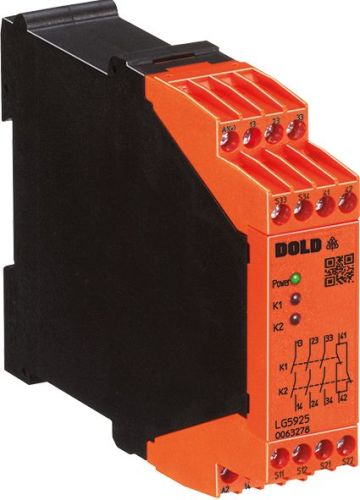
Dold 0063278 LG5925.48/900/61 DC24V light barrier control device
| Lieske Part No. | 1001845 |
|---|---|
| Mfg Part No | 0063278 |
| EAN-Code | 4030641632786 |
| Manufacturer | Dold |
| Here only | 263,51 EUR
313,58 EUR incl. VAT
|
Further information for Dold 0063278 LG5925.48/900/61 DC24V light barrier control device
| Technical data | |
| 1- / 2-channel | 1, 2 |
| Approvals | UL |
| Cat. / PL acc. to EN ISO 13849-1 | 4/e |
| Connection | Pluggable cage clamp terminals, Pluggable screw terminals, Screw terminals |
| Output contacts max. | 4 NO contacts |
| SIL CL acc. to IEC/EN 62061 | 3 |
| SIL acc. to IEC/EN 62061 | 3 |
| Thermal current Ith max. | 8 A |
| Width | 22,5 mm |
| Type | LG 5925/900 |
| Cross fault detection | |
| Variant | |
| Contact equipping | 3 NO contacts, 1 NC contact |
| Nominal voltage | DC 24 V |
| Terminal type | screw terminals fixed |
| Approvals and Markings | UL-listed C/US, TÜV, UKCA, CCC |
Applications
The device is primarily designed for use in safety-relevant systems, particularly in automation technology and the machine-building industry, where reliable and monitored machine shutdown is required. It is used in light barrier systems serving as emergency stop function or safety shutdown. The application in combustion systems highlights its suitability for continuous operation under high requirements for reliability and safety. The devices are designed for light barriers with symmetric or asymmetric outputs, with selection made via switch S1.
Functions and Equipment in Detail
The switching device features cable break detection at the single-button, which can detect incorrect operation or a short circuit in the connection. Activation occurs either via the single-button or via an automatic start function, configured through switch S2. Operating states are visually indicated by LED displays for Channel 1, Channel 2, and supply voltage, enabling quick diagnosis during operation. Cross-short detection ensures that a short circuit between channels is detected, enhancing safety.
Technology Explained Simply
The device operates according to standards for safe control systems and meets the requirements for Performance Level (PL) e and Category 4 in accordance with EN ISO 13849-1. This means it is suitable for applications with the highest safety requirements, where device failure could lead to an immediate hazard scenario. Additionally, it meets the requirements for SIL 3 according to IEC/EN 62061 and IEC/EN 61508, emphasizing the reliability and fault tolerance of the device. The thermal current (Ith) is maximum 8 A, indicating the maximum load capacity of the contacts. The certifications include UL-listed C/US, TÜV, UKCA, and CCC, ensuring international usability in various markets.
Compatibility and Accessories
The device is designed for 1- or 2-channel wiring, allowing flexible use in different safety configurations. Connection options include screw terminals as well as removable spring-loaded terminals and removable screw terminals, with the latter enabling quick installation and maintenance. Wire connections can be made with 2 x 1.5 mm² stranded wire with ferrule and plastic sleeve or 2 x 2.5 mm² solid wire in accordance with DIN 46 228-1/-2/-3/-4. Optional pluggable terminal blocks are available, enabling quick device replacement.
Mounting and Installation
Mounting is performed in standard 35 mm control panels, with the width of 22.5 mm allowing for compact placement. The fixed screw terminal technology ensures a secure connection, while the options for removable terminals support flexible installation and maintenance. The devices are designed for use in industrial environments, with the mentioned certifications ensuring usability in various regions.
Advantages in Operation
The integrated self-test function and cross-short detection increase safety and prevent false alarms. The LED displays allow for quick visual inspection of the operating status. The SIL 3 and PL e certification ensures compliance with the highest safety standards. The flexible connection technology and the option for pluggable terminal blocks simplify installation and maintenance. The suitability for continuous operation in combustion systems demonstrates the robustness and reliability of the device under demanding operating conditions.

This is an offer of:
79279 Vörstetten
https://industry-electronics.com
Tel. 07666/88499-0
Fax. 07666/88499-111
Diesen Artikel finden Sie unter:
industry-electronics.com/artikel/1001845

Lieske Elektronik e.K.
Reutener Str. 1079279 Vörstetten
https://industry-electronics.com
Tel. 07666/88499-0
Fax. 07666/88499-111
Diesen Artikel finden Sie unter:
industry-electronics.com/artikel/1001845