
Dold 0062987 PH9270.91/100/02 AC200-480V AC40A semiconductor contactor UH24VDC
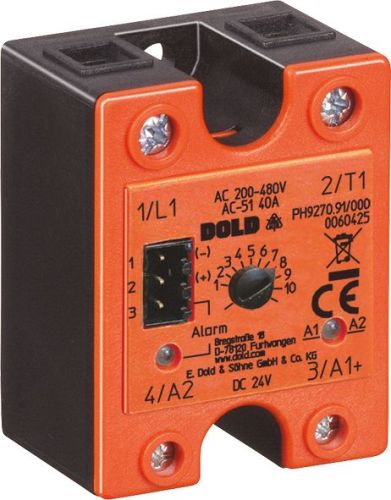
Dold 0062987 PH9270.91/100/02 AC200-480V AC40A semiconductor contactor UH24VDC
| Lieske Part No. | 1001626 |
|---|---|
| Mfg Part No | 0062987 |
| EAN-Code | 4030641629878 |
| Manufacturer | Dold |
| Here only | 210,76 EUR
250,80 EUR incl. VAT
|
Further information for Dold 0062987 PH9270.91/100/02 AC200-480V AC40A semiconductor contactor UH24VDC
| Technical data | |
| Load current up to | 40 A |
| Load voltage up to | AC 480 V |
| Number of poles | 1-pole |
| On/Off Input Control | DC |
| Width | 45 mm |
| Type | PH 9270 |
| Signalling output | |
| Variant | |
| Auxiliary voltage | DC 24 V |
| Load current | AC 40 A |
| Load voltage | AC 200 - 480 V |
| Semiconductor output | 1-pole |
| Variant | Switching at zero crossing. With heigh I2t-value. Control via A1/A2 with under- and over current monitoring and PNP transistor output with de-energized on trip. With heat sink |
Applications
This semiconductor contactor is intended for use in plants where heating elements, motors, valves or lighting systems must be switched frequently and reliably. The integrated load circuit monitoring allows detection of faults such as load circuit interruption, over- or under-current, missing load voltage, fuse failure or thyristor defects. This enables quick fault diagnosis and increases the operational safety of connected machines.
Functions and Equipment in Detail
The device features integrated load circuit monitoring, which continuously monitors load voltage and load current. If deviations from the set load current limit or a defective power semiconductor occur, an alarm output is activated. The alarm output is designed as a PNP semiconductor signal output and operates on the rest current principle, enabling direct connection to PLC systems. Status indication is provided by a dual-colour LED: green indicates fault-free operation, red indicates a fault condition. The LED A1/A2 indicates the status of the control input – yellow means activated, off means not activated.
Technology Explained Simply
The semiconductor contactor operates with zero-voltage switching, meaning that the load circuit is activated at the next zero crossing of the sinusoidal mains voltage as soon as the control voltage is applied. After removal of the control voltage, the device switches off again at the next zero crossing of the load current. This switching method minimizes electrical interference and extends the service life of connected loads. The power electronics are based on two antiparallel-connected thyristors connected via DCB technology (Direct-Copper-Bonding process) to ensure optimal heat dissipation. The width is 45 mm, enabling compact mounting on the DIN rail.
Compatibility and Accessories
The device is designed for mounting on the DIN rail and is supplied with a heatsink to optimize heat dissipation. Optionally, a temperature limit switch (normally open) can be inserted into the designated pocket at the bottom to monitor the heatsink thermally. If the temperature exceeds 100 °C, the switch opens and protects the device from thermal overload. An example of a suitable temperature limit switch is the UCHIYA type UP62 – 100.
Mounting and Installation
Mounting is done on the DIN rail, and installation must only be carried out by a qualified electrician. The connection terminals are clearly labelled: A1+/A2 for the control input, A3+/A2 for the operating voltage and load circuit monitoring, L1 for the mains connection, and T1 for the load output. Control is performed via A1/A2 with under- and over-current monitoring.
Advantages in Operation
The semiconductor contactor offers wear-free operation without mechanical contacts, which increases service life and extends maintenance intervals. The integrated load circuit monitoring enables precise fault detection, minimizing downtime. The combination of zero-voltage switching, DCB technology, and heatsink ensures reliable and efficient heat dissipation, even at high switching frequencies. The PLC-compatible alarm output interface facilitates integration into existing control systems.

This is an offer of:
79279 Vörstetten
https://industry-electronics.com
Tel. 07666/88499-0
Fax. 07666/88499-111
Diesen Artikel finden Sie unter:
industry-electronics.com/artikel/1001626

Lieske Elektronik e.K.
Reutener Str. 1079279 Vörstetten
https://industry-electronics.com
Tel. 07666/88499-0
Fax. 07666/88499-111
Diesen Artikel finden Sie unter:
industry-electronics.com/artikel/1001626