
Dold 0062777 PH9260.91/042 AC48-480V AC50A semiconductor relay DC4-20mA
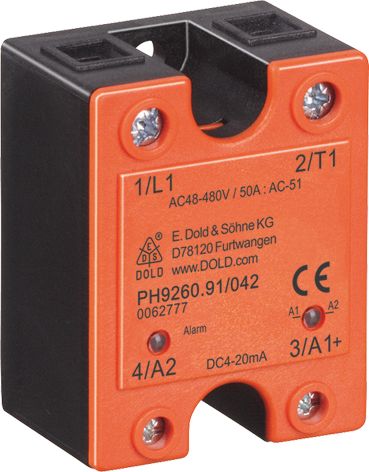
Dold 0062777 PH9260.91/042 AC48-480V AC50A semiconductor relay DC4-20mA
| Lieske Part No. | 1001329 |
|---|---|
| Mfg Part No | 0062777 |
| EAN-Code | 4030641627775 |
| Manufacturer | Dold |
| Here only | 80,69 EUR
96,02 EUR incl. VAT
|
Further information for Dold 0062777 PH9260.91/042 AC48-480V AC50A semiconductor relay DC4-20mA
| Technical data | |
| Analog Input Control | 4 - 20 mA |
| Load current up to | 50 A |
| Load voltage up to | AC 480 V |
| Number of poles | 1-pole |
| Width | 45 mm |
| Type | PH 9260/042 |
| Variant | |
| Control current | DC 4 - 20 mA |
| Load current | AC 50 A |
| Load voltage | AC 48 - 480 V |
| Semiconductor output | 1-pole |
| Variant | Without heat sink |
Applications
This semiconductor relay is particularly suitable for controlling heating elements and infrared lamps. It is used in systems requiring precise temperature control, such as injection moulding machines in the plastics and rubber industry, thermoforming and packaging machines, as well as in the food industry. The zero-voltage switching technology enables noiseless and fast switching, which is advantageous for process control in sensitive production environments.
Functions and equipment in detail
The device operates with two antiparallel-connected thyristors and switches always at the zero crossing of the sinusoidal mains voltage. This ensures excellent EMC properties, as no disturbances are caused by sudden voltage changes. The output control is proportional to the control current: a control current of 4 to 20 mA is converted into an on/off ratio of 0 to 100 %. Two LEDs serve as status indicators: a yellow LED indicates the operating voltage and control current, with the blinking cycle corresponding to the set on/off ratio. A red LED indicates fault conditions – slowly blinking when the control current is below 4 mA, rapidly blinking when the control current exceeds 21 mA.
Technology explained simply
Pulse packet control enables self-optimised distribution of switching pulses with minimised cycle times. This achieves precise temperature control, as the heat output is continuously and finely adjusted. The device is designed without a heatsink, although a version with a heatsink for mounting on a DIN rail is available as an option. The box terminals allow for secure and easy connection of the wires. The touch protection IP20 ensures protection against contact with moving parts and against solid objects larger than 12.5 mm.
Compatibility and accessories
The semiconductor relay is designed for loads in AC-51 switching duty. It can be optionally equipped with an overtemperature protection, where a temperature limit switch (normally open) is inserted into a designated slot at the bottom of the device. If the heatsink temperature exceeds 100 °C, the switch opens and protects the device from thermal overload. An example of a suitable temperature limit switch is the type UP62-100 from UCHIYA.
Mounting and installation
The device has a width of 45 mm and is designed for mounting on a DIN rail, with the version without heatsink mounted directly. The connection terminals are rated for a wire cross-section of 1.5 mm², with the load circuit secured using M4 Pozidriv screws. The mounting screws should be tightened with a torque of 1.2 Nm. The rated insulation voltage between control and load circuit is 4 kV rms, as well as between load circuit and enclosure base plate. The overvoltage category is II.
Advantages in operation
The zero-voltage switching technology ensures minimal electromagnetic compatibility (EMC) and prevents disturbances in the network. The self-optimised pulse distribution enables precise temperature control, which is critical for many industrial processes. The device is robust and designed for use in demanding environments, with the LED indicators enabling quick diagnosis of operating conditions and faults. The analogue control via DC 4–20 mA is standardised in many industrial control loops and ensures easy integration into existing systems.

This is an offer of:
79279 Vörstetten
https://industry-electronics.com
Tel. 07666/88499-0
Fax. 07666/88499-111
Diesen Artikel finden Sie unter:
industry-electronics.com/artikel/1001329

Lieske Elektronik e.K.
Reutener Str. 1079279 Vörstetten
https://industry-electronics.com
Tel. 07666/88499-0
Fax. 07666/88499-111
Diesen Artikel finden Sie unter:
industry-electronics.com/artikel/1001329