
Dold 0062432 semiconductor relay AC24-240V AC25A
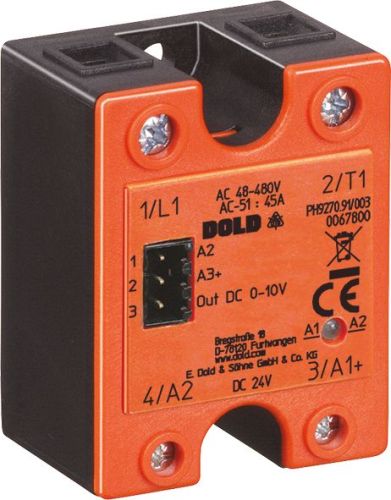
Dold 0062432 semiconductor relay AC24-240V AC25A
| Lieske Part No. | 1001323 |
|---|---|
| Mfg Part No | 0062432 |
| EAN-Code | 4030641624323 |
| Manufacturer | Dold |
| Here only | 175,71 EUR
209,09 EUR incl. VAT
|
Further information for Dold 0062432 semiconductor relay AC24-240V AC25A
| Technical data | |
| Load current up to | 45 A |
| Load voltage up to | AC 480 V |
| Number of poles | 1-pole |
| On/Off Input Control | DC |
| Width | 45 mm |
| Type | PH 9270/003 |
| Signalling output | |
| Variant | |
| Analogue output | DC 0 - 10 V |
| Auxiliary voltage | DC 24 V |
| Load current | AC 25 A |
| Load voltage | AC 24 - 240 V |
| Semiconductor output | 1-pole |
| Variant | Switching at zero crossing. With analogue output. Without heat sink |
Applications
This semiconductor relay is particularly suitable for applications requiring precise and continuous current monitoring, such as in injection moulding machines in the plastics and rubber industry, thermoforming and packaging machines, and in the food industry. The ability to measure the load current as true RMS value enables accurate detection even with non-sinusoidal loads. The integrated monitoring function supports early fault detection, increasing productivity.
Functions and Equipment in Detail
The device features an analogue output DC 0–10 V, proportional to the load current, which can be directly connected to PLC systems or display modules with analogue input. The LED indicator at the control input (A1+/A2) signals the operating status: yellow illuminated when the relay is activated, off when not activated. The DCB technology (Direct-Copper-Bonding process) ensures optimal heat dissipation and increases the device’s service life. The version without heatsink is suitable for applications with low thermal load.
Technology Explained Simply
The relay operates with two antiparallel-connected thyristors configured as a zero-voltage switch. This means that switching always occurs at the voltage zero crossing, minimising electromagnetic interference. Load current measurement is continuous, and the output signal is provided in real time via the analogue output. Control is via a digital input with DC actuation. The frequency range of 47–63 Hz indicates compatibility with standard supply voltages in Europe and other regions.
Compatibility and Accessories
The relay is compliant with IEC/EN 60947-4-3 and can be used in industrial control systems. An optional version with heatsink is available, which clips onto the DIN rail and provides improved heat dissipation. For thermal protection, a temperature limit switch (normally open) can be inserted into a designated pocket on the device; a type such as UCHIYA UP62–100 is recommended. This switch disconnects when a predefined temperature (e.g. 100 °C) is exceeded.
Mounting and Installation
Mounting is on the DIN rail with a width of 45 mm. Installation must be carried out by a qualified electrician. Terminal markings are clearly defined: A1+/A2 for the control input, A3+/A2 for the operating voltage and load current measurement, Out for the analogue output, L1 for the supply connection, and T1 for the load output.
Advantages in Operation
The relay is wear-free, noiseless, and economical in operation. The integrated load current measurement enables precise monitoring and early fault detection. The zero-voltage switching ensures high EMC compatibility. The analogue output facilitates integration into existing control systems. The DCB technology ensures efficient heat dissipation and increases the reliability of the device.

This is an offer of:
79279 Vörstetten
https://industry-electronics.com
Tel. 07666/88499-0
Fax. 07666/88499-111
Diesen Artikel finden Sie unter:
industry-electronics.com/artikel/1001323

Lieske Elektronik e.K.
Reutener Str. 1079279 Vörstetten
https://industry-electronics.com
Tel. 07666/88499-0
Fax. 07666/88499-111
Diesen Artikel finden Sie unter:
industry-electronics.com/artikel/1001323