
Dold 0061520 semiconductor contactor AC24-115V AC10A
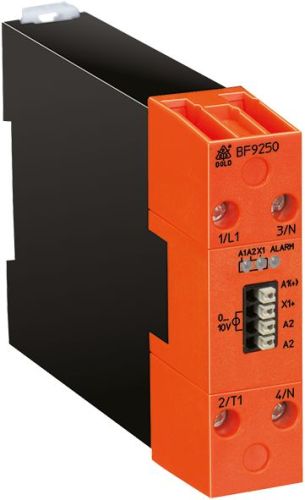
Dold 0061520 semiconductor contactor AC24-115V AC10A
| Lieske Part No. | 1001490 |
|---|---|
| Mfg Part No | 0061520 |
| EAN-Code | 4030641615208 |
| Manufacturer | Dold |
| Here only | 210,30 EUR
250,26 EUR incl. VAT
|
Further information for Dold 0061520 semiconductor contactor AC24-115V AC10A
| Technical data | |
| Analog Input Control | 4 - 20 mA |
| Approvals | UL |
| Load current up to | 50 A |
| Load voltage up to | AC 480 V |
| Number of poles | 1-pole |
| Width | 22,5 mm, 45 mm, 90 mm |
| Type | BF 9250/0_2 |
| Temperature monitoring | |
| Variant | |
| Auxiliary voltage | AC/DC 24 V |
| Contact equipping | without signal contact |
| Control input | DC 0 - 10 V |
| Load current | AC 10 A |
| Load voltage | AC 24 - 115 V |
| Semiconductor output | 1-pole |
| Approvals and Markings | UL-listed C/US |
| Variant | Self optimising, to achieve as short as possible control periods, suitable for infrared lamps |
Applications
This semiconductor contactor is designed for use in industrial heating systems, particularly in plants requiring precise and disturbance-free temperature control. Typical application areas include heating plates, drying systems, infrared heaters, and other heat generators controlled via an analogue regulator. The zero-voltage switching minimises electromagnetic interference and ensures a clean switching characteristic, which is especially important in sensitive production environments.
Functions and equipment in detail
The device features an LED display indicating the operating status visually: the green LED indicates supply voltage, the yellow LED indicates output status (on), and the red LED indicates faults. In case of a synchronisation error, control input fault, or overheating of the power semiconductor, the red LED flashes (non-latching) or remains lit continuously (latching in case of overheating). The overheating alarm is latching and requires a brief interruption of the supply voltage to reset. The temperature protection function protects the power semiconductor from overheating and extends the device's service life.
Technology explained simply
The pulse packet control operates on the principle of zero-voltage switching, where the switch only operates at the zero-crossing point of the alternating voltage. This minimises switching disturbances and prevents sparking. Control is via an analogue input, which can be operated as voltage (0–10 V) or current (4–20 mA). The control resolution for this variant is 5 %, enabling fine adjustment of load power. The load voltage can reach up to AC 480 V, and the load current is AC 10 A. The auxiliary voltage is AC/DC 24 V, with a current consumption of less than 26 mA. The varistor protection circuit protects the device against transient voltage spikes.
Compatibility and accessories
The semiconductor contactor is suitable for loads in the range AC 24–115 V, AC 110–240 V, and AC 230–480 V. It is designed for resistive loads and can be used in continuous operation. The width is 22.5 mm, making it suitable for mounting on DIN rail. Installation requires a minimum clearance of 20 mm above and below, and 10 mm laterally from the cable duct, to ensure sufficient cooling. The UL-listed C/US certification confirms suitability for use in the USA and Canada.
Mounting and installation
The device can be clipped onto DIN rail and can thus be easily integrated into existing enclosures. The connection terminals are clearly labelled: A1 (+) and A2 (-) for auxiliary voltage, X1 for control input, L1/N for mains connections, and T1/N for load output. Mounting is in a closed enclosure, with ambient temperature between 0 °C and 40 °C. Above 40 °C, current derating occurs to limit thermal stress.
Advantages in operation
The zero-voltage switching ensures disturbance-free and noiseless operation, increasing the service life of both the load and the contactor. The LED indicators enable quick fault diagnosis, and the integrated temperature protection function protects the device from thermal overload. The self-optimised pulse distribution enables precise control, especially for infrared lamps requiring short switching cycles. Compatibility with various control types (voltage, current, potentiometer) increases flexibility when integrating into existing systems.

This is an offer of:
79279 Vörstetten
https://industry-electronics.com
Tel. 07666/88499-0
Fax. 07666/88499-111
Diesen Artikel finden Sie unter:
industry-electronics.com/artikel/1001490

Lieske Elektronik e.K.
Reutener Str. 1079279 Vörstetten
https://industry-electronics.com
Tel. 07666/88499-0
Fax. 07666/88499-111
Diesen Artikel finden Sie unter:
industry-electronics.com/artikel/1001490