
Dold 0061276 RK7816.32 AC230V+AC/DC24V blink relay 0.1–1 s
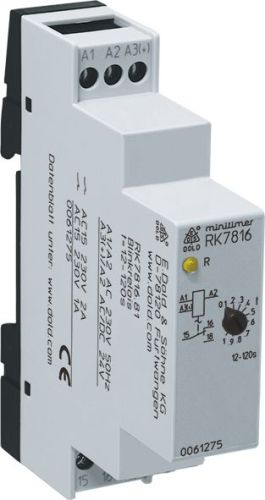
Dold 0061276 RK7816.32 AC230V+AC/DC24V blink relay 0.1–1 s
| Lieske Part No. | 1000844 |
|---|---|
| Mfg Part No | 0061276 |
| EAN-Code | 4030641612764 |
| Manufacturer | Dold |
| Here only | 65,23 EUR
77,62 EUR incl. VAT
|
Further information for Dold 0061276 RK7816.32 AC230V+AC/DC24V blink relay 0.1–1 s
| Technical data | |
| Approvals | UL |
| Enclosure design | Distribution board |
| Output contacts | 1 C/O contact |
| Time function(s) | Flasher relay |
| Time range | 0,1 s - 10 h |
| Width | 17,5 mm |
| Type | RK 7816 |
| Variant | |
| Contact equipping | 1 changeover contact delayed, 1 changeover contact instantaneous |
| Nominal voltage | AC 230 V + AC/DC 24 V |
| Pulse time | 0,1 - 1 s |
| Variant | Start with impulse |
Applications
This relay is suitable for applications requiring a periodic switching sequence, for example, for controlling warning lights, signal systems, or in building automation systems. The Start with pulse function enables precise control of the start behavior, allowing the device to be used in complex control sequences. The time ranges extend from 0.1 seconds to 10 hours, with the pulse time adjustable between 0.1 and 1 second. Time adjustment is performed continuously on a relative scale with a ratio of 1:10.
Functions and Equipment in Detail
The device features two output contacts: one delayed changeover contact (contact 15-16-18) and one instantaneous contact (contact 21-22-24). The contact configuration allows simultaneous control of two loads, with the first contact switching delayed and the second reacting immediately. The LED indicator signals the closed state of the first changeover contact (15-18). The reset time is less than 100 ms, and the repeatability is ≤ 0.5 % of the set time range end value plus 10 ms. Voltage influence values are ≤ 1 %, and temperature influence is 0.25 % per Kelvin.
Technology Explained Simply
The blink relay operates on the principle of time-delayed switching, where the pulse time determines the duration of individual switching phases. The Start with pulse function means the relay activates only after a short input pulse, which is necessary in certain control sequences. The combination of delayed and instantaneous changeover contacts allows flexible control of loads, for example, one lamp can be switched on with delay while another is activated immediately. Adjustment is made via a rotary control on the front of the device.
Compatibility and Accessories
The device is part of the RK series from Dold, which includes various time functions, such as delayed-response relays (RK 7813, RK 7814), wipe relays (RK 7815), and blink relays (RK 7816). The dual-voltage version (AC 230 V + AC/DC 24 V) enables use under different mains voltage conditions. Devices in the RK series are designed for use in installation distributor housings and comply with the standard IEC/EN 61812-1. UL certification is also available.
Mounting and Installation
The relay is installed in standard installation distributor housings with a width of 17.5 mm. Mounting is done via screw terminals designed for connection wires. Terminal designations are detailed in the datasheet: A1, A3(+), A2 for auxiliary voltage, Z3, Z4, Z5 for programming (for RK 7814), and contacts 15-16-18 and 21-22-24 for output contacts. The connection terminals are designed for secure connections.
Operational Advantages
The combination of compact design, flexible contact configuration, and adjustable pulse time makes the RK7816.32 a versatile component for time-controlled applications. The LED indicator facilitates diagnostics during operation, and the low reset time ensures quick response after a switching event. High repeatability and low dependence on voltage and temperature ensure reliable operation under various operating conditions. UL certification and compliance with IEC/EN 61812-1 ensure suitability for use in various markets.

This is an offer of:
79279 Vörstetten
https://industry-electronics.com
Tel. 07666/88499-0
Fax. 07666/88499-111
Diesen Artikel finden Sie unter:
industry-electronics.com/artikel/1000844

Lieske Elektronik e.K.
Reutener Str. 1079279 Vörstetten
https://industry-electronics.com
Tel. 07666/88499-0
Fax. 07666/88499-111
Diesen Artikel finden Sie unter:
industry-electronics.com/artikel/1000844