
Dold 0061174 emergency stop module BH5928.92/61 DC24V 0,1-1S
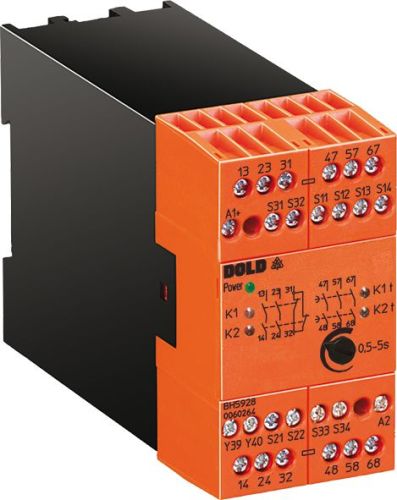
Dold 0061174 emergency stop module BH5928.92/61 DC24V 0,1-1S
| Lieske Part No. | 1001968 |
|---|---|
| Mfg Part No | 0061174 |
| EAN-Code | 4030641611743 |
| Manufacturer | Dold |
| Here only | 507,41 EUR
603,82 EUR incl. VAT
|
Further information for Dold 0061174 emergency stop module BH5928.92/61 DC24V 0,1-1S
| Technical data | |
| 1- / 2-channel | 1, 2 |
| Approvals | UL |
| Cat. / PL acc. to EN ISO 13849-1 | 4/e |
| Connection | Pluggable screw terminals |
| Output contacts max. | 3 NO contacts, 3 NO contacts delayed |
| SIL CL acc. to IEC/EN 62061 | 3 |
| SIL acc. to IEC/EN 62061 | 3 |
| Thermal current Ith max. | 5 A |
| Width | 45 mm |
| Type | BH 5928 |
| Cross fault detection | |
| Suited as safety gate monitor | |
| Variant | |
| Contact equipping | 2 NO contacts, 1 NC contact instantaneous, 3 NO contacts off delay |
| Nominal voltage | DC 24 V |
| Time range | 0,1 - 1 s |
| Approvals and Markings | UL-listed C/US, TÜV, CCC |
| Variant | With adjustable time delay |
Applications
This module is used in industrial systems where safe and reliable machine shutdown is required. It is particularly suitable for applications requiring a delayed reset time to ensure that moving parts have come to a complete stop before operation resumes. The function as a safety door monitor enables monitoring of access protection systems, thereby increasing the safety of operating personnel.
Functions and Equipment in Detail
The device features contact configuration with 2 NO contacts, 1 NC contact immediately, and 3 NO contacts with delayed reset. The time delay is adjustable and ranges from 0.1 to 1 second. The output contacts are rated for a thermal current of up to 5 A. Connection is made via removable screw terminals, enabling flexible and secure connections. Wire connections can be made with stranded wires of 2 x 1.5 mm² (with ferrule and plastic sleeve DIN 46 228-1/-2/-3/-4) or 2 x 2.5 mm² (with ferrule DIN 46 228-1/-2/-3).
Technology Explained Simply
The time delay ensures that the emergency stop command does not take effect immediately, but after a defined delay. This is particularly important to ensure that moving machine parts have fully stopped before operation resumes. The delayed reset contacts ensure that the machine cannot be restarted immediately after pressing the emergency stop button, but only after the set delay time has elapsed. The status indicator for the delayed reset circuit, as well as LED indicators for power, channel 1/2, and time delay, enable visual monitoring of the operating status.
Compatibility and Accessories
The module is suitable for single- or dual-channel wiring, allowing flexible integration into different safety architectures. It features cross-circuit detection, which is activated when buttons are connected to terminals S33–S34. Activation occurs either via a single button at S33–S34 or via an automatic single-function with a bridge at S13–S14. Certifications include UL-listed C/US, TÜV, and CCC, confirming suitability for use in various markets.
Mounting and Installation
Mounting is done in standard control panels with a width of 45 mm. The removable terminal blocks facilitate installation and maintenance. The connection terminals are clearly labeled to ensure error-free wiring. Compliance with safety instructions and the guidelines in the datasheet is required to ensure functional safety.
Advantages in Operation
The module offers high safety performance with Performance Level (PL) e and Category 4 according to EN ISO 13849-1, as well as Safety Integrity Level (SIL CL) 3 according to IEC/EN 62061. The integrated cross-circuit detection increases system reliability by detecting faults in the control circuit. The LED indicators enable quick diagnosis of the operating status, reducing maintenance and downtime. The adjustable time delay provides flexibility in adapting to different machine requirements.

This is an offer of:
79279 Vörstetten
https://industry-electronics.com
Tel. 07666/88499-0
Fax. 07666/88499-111
Diesen Artikel finden Sie unter:
industry-electronics.com/artikel/1001968

Lieske Elektronik e.K.
Reutener Str. 1079279 Vörstetten
https://industry-electronics.com
Tel. 07666/88499-0
Fax. 07666/88499-111
Diesen Artikel finden Sie unter:
industry-electronics.com/artikel/1001968