
Dold 0060953 GF9016 3AC50/60Hz200V UHDC24V 5.5kW soft starter
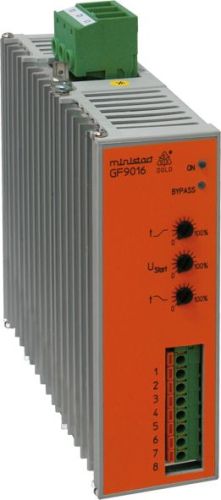
Dold 0060953 GF9016 3AC50/60Hz200V UHDC24V 5.5kW soft starter
| Lieske Part No. | 1151995 |
|---|---|
| Mfg Part No | 0060953 |
| EAN-Code | 4030641609535 |
| Manufacturer | Dold |
| Here only | 550,05 EUR
654,56 EUR incl. VAT
|
Further information for Dold 0060953 GF9016 3AC50/60Hz200V UHDC24V 5.5kW soft starter
| Technical data | |
| Extra functions | Mains monitoring, Temperature monitoring |
| For three-phase motors, 400 V up to | 22 kW |
| Load voltage up to | 3AC 400 V |
| Width | 45 mm, 52,5 mm |
| Type | GF 9016 |
| Signalling output | |
| Variant | |
| Auxiliary voltage | DC 24 V |
| Mains / motor voltage | 3AC 200 V |
| Nominal motor power | 5,5 kW |
| Approvals and Markings | UKCA |
Applications
The device is designed for use in industrial plants where smooth start-up and shutdown are required to protect mechanical components and relieve the power grid. It is particularly suitable for drives with high inertia or sensitive loads, where sudden torque changes could cause damage. Application areas include conveyor systems, pumps, fans, compressors, packaging machines, and door drives.
Functions and Equipment in Detail
The device features separate adjustment options for start-up and shutdown time, as well as start-up voltage. Optionally, a kickstart function can be activated to support the start-up process. Control is performed via terminals X2 (Start/Stop) and X3 (Kickstart). The auxiliary voltage is DC 24 V. An alarm output is integrated, signaling faults and the bypass status via terminals X5/X6 and X7/X8. Indication is provided by a green LED (ready for operation) and a yellow LED (fault or operating status). Fault codes are displayed via different flashing patterns of the yellow LED, with faults 1 to 8 indicating specific issues such as supply voltage failure, overload, electronic failure, or phase failure.
Technology Explained Simply
Control is achieved via phase-cut control, where two motor phases are controlled via thyristors to gradually increase current and torque. The third phase is connected directly. Control is performed via a ramp control, which gradually increases voltage. After start-up, the device is bypassed via an internal relay to minimize power losses. Network monitoring and temperature monitoring ensure safe operation. The device construction complies with the standard IEC/EN 60947-4-2.
Compatibility and Accessories
The device is designed for 3-phase asynchronous motors operated at a supply/motor voltage of 3AC 200 V. The motor rated power is 5.5 kW, with the device suitable for motors up to 22 kW at 400 V. The load voltage can reach up to 3AC 400 V. The width is 45 mm for motors up to 15 kW and 52.5 mm for motors up to 22 kW. W3 wiring is possible. Approvals include the UKCA mark.
Mounting and Installation
Mounting is carried out in an enclosure or control unit. The connection terminals are clearly labeled: L1, L2, L3 for supply voltage, T1, T2, T3 for motor voltage, X1 for +24 V (output), X2 for Start/Stop, X3 for Kickstart, X4 for 0 V, X5/X6 for alarm output (fault), X7/X8 for alarm output (device bypassed). Installation is carried out according to the manufacturer’s technical instructions. Cooling is achieved via natural convection; forced cooling may be beneficial at high start frequencies or ambient temperatures.
Advantages in Operation
Smooth start-up and shutdown control reduce wear on motors and mechanical drive components, increasing service life. Reducing start-up currents relieves the supplying power grid. Simple and space-saving installation facilitates integration into existing plants. Integrated network and temperature monitoring, along with alarm outputs, enable reliable operational monitoring. The W3 wiring expands application possibilities in certain plant configurations.

This is an offer of:
79279 Vörstetten
https://industry-electronics.com
Tel. 07666/88499-0
Fax. 07666/88499-111
Diesen Artikel finden Sie unter:
industry-electronics.com/artikel/1151995

Lieske Elektronik e.K.
Reutener Str. 1079279 Vörstetten
https://industry-electronics.com
Tel. 07666/88499-0
Fax. 07666/88499-111
Diesen Artikel finden Sie unter:
industry-electronics.com/artikel/1151995