
Dold 0060945 frequency monitor MH9143.38 +/-5Hz
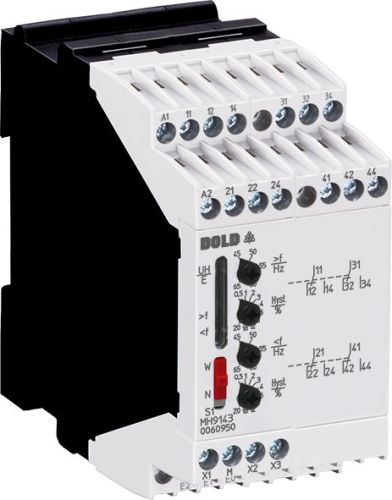
Dold 0060945 frequency monitor MH9143.38 +/-5Hz
| Lieske Part No. | 1001924 |
|---|---|
| Mfg Part No | 0060945 |
| EAN-Code | 4030641609450 |
| Manufacturer | Dold |
| Here only | 332,76 EUR
395,98 EUR incl. VAT
|
Further information for Dold 0060945 frequency monitor MH9143.38 +/-5Hz
| Technical data | |
| 1- / 3-phase | 1 |
| Enclosure design | Switch cabinet |
| Measuring range max. | 50/60 Hz |
| Output contacts | 2 x 2 C/O contacts |
| Standard measuring range | 50/60 Hz |
| Width | 45 mm |
| Type | MH 9143 |
| Auxiliary voltage required | |
| Operate delay | |
| Variant | |
| Alarm delay | 0 - 20 s |
| Auxiliary voltage | AC/DC 110 - 230 V |
| Contact equipping | 2 x 1 changeover contact |
| Response value | + / - [0.1 - 5] Hz |
| Start up delay | 0 - 30 s |
| Variant | Adjustable tripping values via 10-step switch. Adjustable time delay. Start up delay activatable via terminals |
Applications
The MH 9143.38 is used to monitor frequency stability in decentralized power supplies. Typical applications include monitoring of emergency power units, diesel generators, or local power grids, where stable frequency is essential for the operation of electrical systems. The device is designed for single-phase networks and monitors frequency in the range of 50/60 Hz.
Functions and equipment in detail
The alarm thresholds for over- and under-frequency are adjustable via a 10-step switch and range from ±0.1 Hz to ±5 Hz relative to the set frequency. The set frequency can be switched between 50 Hz and 60 Hz. The alarm delay is separately adjustable for over- and under-frequency and ranges from 0 to 20 seconds. A start-up bypass is adjustable via terminals and can be configured in the range of 0 to 30 seconds. The output contacts consist of 2 x 2 changeover contacts, where the relays for over-frequency alarm are switchable (operating or de-energized principle), while the relay for under-frequency alarm operates on the de-energized principle (drops out at under-frequency). The auxiliary voltage is AC/DC 110–230 V and is required for operation.
Technology explained simply
The device measures the frequency of the connected network via a universal input, designed for voltages from AC 40 to 550 V. The measurement is performed with high immunity to interference to avoid false alarms caused by network disturbances. The alarm thresholds are precisely and reproducibly adjustable, ensuring reliable monitoring. The time delay prevents short-term false alarms caused by transient frequency fluctuations. The width of the device is 45 mm, enabling compact installation in standard enclosures.
Compatibility and accessories
The device is designed for use in industrial systems and can be combined with other components of the VARIMETER series. The connection terminals are standardized, enabling easy integration into existing control systems. The LED indicators signal the operating status of the auxiliary voltage, the input frequency, and the alarm states for over- and under-frequency.
Mounting and installation
The network frequency monitor is mounted in enclosures. The connection terminals are clearly labeled: A1/A2 for auxiliary voltage, E0–E2 for frequency input, X1–X3 for programming terminals. Mounting is done via screw terminals suitable for connection to wires. The terminal designations correspond to the specifications in the data sheet.
Advantages in operation
Precise frequency measurement and fast response time ensure reliable alarm functionality. The separate relay outputs for over- and under-frequency allow differentiated responses to frequency deviations. The adjustable delays and start-up bypass prevent unwanted alarms during short-term fluctuations or during generator start-up. The LED indicators provide a visual overview of the device’s operating status.

This is an offer of:
79279 Vörstetten
https://industry-electronics.com
Tel. 07666/88499-0
Fax. 07666/88499-111
Diesen Artikel finden Sie unter:
industry-electronics.com/artikel/1001924

Lieske Elektronik e.K.
Reutener Str. 1079279 Vörstetten
https://industry-electronics.com
Tel. 07666/88499-0
Fax. 07666/88499-111
Diesen Artikel finden Sie unter:
industry-electronics.com/artikel/1001924