
Dold 0060311 GF9016 3AC50/60Hz 230V 7.5kW soft starter
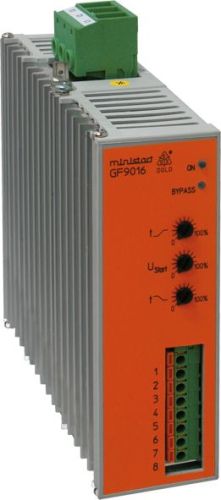
Dold 0060311 GF9016 3AC50/60Hz 230V 7.5kW soft starter
| Lieske Part No. | 115202 |
|---|---|
| Mfg Part No | 0060311 |
| EAN-Code | 4030641603113 |
| Manufacturer | Dold |
| Here only | 614,63 EUR
731,41 EUR incl. VAT
|
Further information for Dold 0060311 GF9016 3AC50/60Hz 230V 7.5kW soft starter
| Technical data | |
| Extra functions | Mains monitoring, Temperature monitoring |
| For three-phase motors, 400 V up to | 22 kW |
| Load voltage up to | 3AC 400 V |
| Width | 45 mm, 52,5 mm |
| Type | GF 9016 |
| Signalling output | |
| Variant | |
| Auxiliary voltage | Without |
| Mains / motor voltage | 3AC 230 V |
| Nominal motor power | 7,5 kW |
| Approvals and Markings | UKCA |
Applications
This device is suitable for drives in industrial applications, particularly for machines with gear, belt, or chain drives, conveyor belts, fans, pumps, compressors, woodworking machines, centrifuges, packaging machines, and door drives. It reduces mechanical stress on drive components and extends the service life of motors and connected machinery. The reduction of inrush currents also relieves the supplying network.
Functions and Features in Detail
The GF9016 features a 2-phase motor control system, with separate adjustable settings for start-up time, shut-down time, and start-up voltage. An optional Kickstart function can be activated to assist the start-up process. The device operates without auxiliary voltage and is therefore independent of additional power sources. The W3 circuit configuration is possible, enabling flexible integration into existing installations. The width is 45 mm for motors up to 15 kW and 52.5 mm for motors up to 22 kW, ensuring space-saving installation in enclosures.
Technology Explained Simply
Control is achieved via phase-cut control, where the voltage to two motor phases is gradually increased. This results in a continuous rise in current and torque. The third phase is connected directly, ensuring stable speed during start-up. Integrated mains monitoring and temperature monitoring ensure safe operation. In case of faults, a yellow LED blinks at a specific frequency to indicate a fault code. A green LED indicates the ready-to-operate status. The alarm outputs (X5/X6 and X7/X8) allow connection to external control systems or warning systems.
Compatibility and Accessories
The device is designed for 3-phase asynchronous motors operated at 3AC 400 V, with a maximum motor power of 22 kW. The load voltage can be up to 3AC 400 V. The terminal connections are designed for connecting supply voltage, motor, and control signals. Terminal markings include L1, L2, L3 (line voltage), T1, T2, T3 (motor voltage), and X1 to X8 for control and alarm outputs. The device configuration complies with the standard IEC/EN 60947-4-2.
Mounting and Installation
The device is designed for installation in enclosures and can be mounted in standard control panels. The width of 45 mm (up to 15 kW) or 52.5 mm (up to 22 kW) allows for compact placement. The terminal connections are clearly labeled, simplifying installation. Control is via inputs X2 (Start/Stop) and X3 (Kickstart). The alarm outputs X5/X6 and X7/X8 can be connected to external systems to indicate faults or the bypass status.
Operational Advantages
The soft start and stop reduce mechanical stress on drive components, resulting in less wear and longer motor life. The reduction of inrush currents relieves the supplying network and reduces the risk of voltage dips. Integrated monitoring functions (mains and temperature monitoring) enhance operational safety. Simple operation and clear indication of operating states and faults facilitate maintenance and diagnostics.

This is an offer of:
79279 Vörstetten
https://industry-electronics.com
Tel. 07666/88499-0
Fax. 07666/88499-111
Diesen Artikel finden Sie unter:
industry-electronics.com/artikel/115202

Lieske Elektronik e.K.
Reutener Str. 1079279 Vörstetten
https://industry-electronics.com
Tel. 07666/88499-0
Fax. 07666/88499-111
Diesen Artikel finden Sie unter:
industry-electronics.com/artikel/115202