
Dold 0060222 semiconductor contactor AC/DC24V 10K
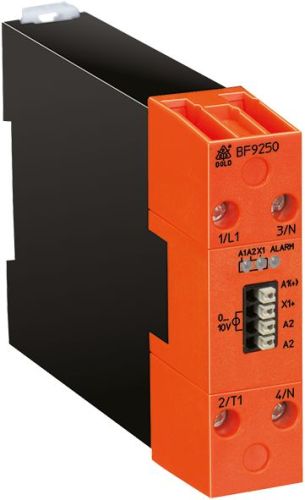
Dold 0060222 semiconductor contactor AC/DC24V 10K
| Lieske Part No. | 1001510 |
|---|---|
| Mfg Part No | 0060222 |
| EAN-Code | 4030641602222 |
| Manufacturer | Dold |
| Here only | 235,00 EUR
279,65 EUR incl. VAT
|
Further information for Dold 0060222 semiconductor contactor AC/DC24V 10K
| Technical data | |
| Analog Input Control | 4 - 20 mA |
| Approvals | UL |
| Load current up to | 50 A |
| Load voltage up to | AC 480 V |
| Number of poles | 1-pole |
| Width | 22,5 mm, 45 mm, 90 mm |
| Type | BF 9250/0_2 |
| Temperature monitoring | |
| Variant | |
| Auxiliary voltage | AC/DC 24 V |
| Contact equipping | without signal contact |
| Control input | remote poti 10 kOhm |
| Load current | AC 25 A |
| Load voltage | AC 110 - 240 V |
| Semiconductor output | 1-pole |
| Approvals and Markings | UL-listed C/US |
| Variant | Output control with fixed period of 64 cycles |
Applications
This device is specifically designed for controlling ohmic loads such as heating rods, heating plates, or infrared lamps. It is used in systems where precise temperature control is required, such as in food processing, plastic processing, or painting and drying technology. The pulse packet control allows for fine adjustment of power output, enabling precise temperature maintenance without continuously switching the load on and off.
Functions and Equipment in Detail
The contactor features a control input as a remote potentiometer with 10 kOhm, operated via an analog signal level of 4 to 20 mA. Alternatively, voltage inputs (0–10 V) or resistance inputs (0–10 kΩ) can also be used. Control is achieved through a linear distribution of pulses over 64 cycles, enabling a high resolution of 1.5625 %. This ensures fine and even power regulation. The zero-voltage switching function ensures that the contactor switches only at the zero crossing of the mains voltage, minimizing network disturbances and increasing the lifespan of the semiconductors.
Technology Explained Simply
The device operates as a semiconductor contactor with a single-pole output, designed for load voltages of AC 110 to 240 V and load currents up to AC 25 A. The maximum rated voltage is AC 480 V, and the maximum rated current is AC 50 A. The auxiliary voltage is AC/DC 24 V. The varistor protection circuit protects the device against transient overvoltages. An integrated temperature protection for the power semiconductors monitors component temperature and switches off the output in case of overheating to prevent damage. The LED indicators signal the operating status: green LED for supply voltage, yellow LED for output status, and red LED for error messages such as synchronization errors, control input errors, or overheating. The overheating message is latching and requires a brief interruption of the supply voltage to reset.
Compatibility and Accessories
The device is compliant with IEC/EN 60947-4-2 and IEC/EN 60947-4-3 standards and carries the UL-listed C/US approval. It is designed for use in electrical installations with an operating temperature of 0 to 40 °C and a maximum air humidity of 75 % (non-condensing). The width is 45 mm, corresponding to the variant up to 25 A. The device is snap-on mountable on DIN rail, enabling easy integration into existing control systems.
Mounting and Installation
Mounting is done on a DIN rail, with recommended clearances of at least 10 mm laterally and 20 mm above/below adjacent devices to ensure sufficient cooling. Connections are made via terminals: A1 (+) and A2 (-) for auxiliary voltage, X1 for control input, L1/N for mains connections, and T1/N for load output. The terminal connections are designed for secure and reliable connections.
Advantages in Operation
Operation of the semiconductor contactor is noiseless and allows for rapid response to changes in the control signal. Pulse packet control ensures even power delivery and minimizes thermal stress on the load. Integrated protection functions such as varistor protection, temperature protection, and zero-voltage switching increase the reliability and lifespan of the device. The LED indicators enable quick diagnosis of operating conditions and faults, simplifying maintenance and servicing.

This is an offer of:
79279 Vörstetten
https://industry-electronics.com
Tel. 07666/88499-0
Fax. 07666/88499-111
Diesen Artikel finden Sie unter:
industry-electronics.com/artikel/1001510

Lieske Elektronik e.K.
Reutener Str. 1079279 Vörstetten
https://industry-electronics.com
Tel. 07666/88499-0
Fax. 07666/88499-111
Diesen Artikel finden Sie unter:
industry-electronics.com/artikel/1001510