
Dold 0060029 RP5994S AC230V base module
Industrial Material > Industrial relays and contactors > Electronic modules
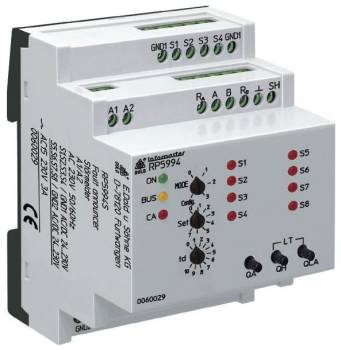
Dold 0060029 RP5994S AC230V base module
| Lieske Part No. | 1323598 |
|---|---|
| Mfg Part No | 0060029 |
| EAN-Code | 4030641600297 |
| Manufacturer | Dold |
| Here only | 394,15 EUR
469,04 EUR incl. VAT
|
Further information for Dold 0060029 RP5994S AC230V base module
| Technical data | |
| Alarm inputs | 8 |
| Alarm inputs extendable up to | 88 |
| Enclosure design | Distribution board |
| Operating principle | De-energized on trip, Energized on trip |
| Optical signal | LED |
| Special features | Bus-compatible, Configurable |
| Width | 70 mm |
| Type | RP 5994 |
| Operate delay | |
| Optional buzzer | |
| Variant | |
| Contact equipping | 2 x 1 NO contact |
| Nominal voltage | AC 230 V |
| Terminal type | screw terminal fixed |
| Variant | RS485 Bus not isolated |
Applications
The module is primarily designed for monitoring industrial processes where rapid detection and indication of faults are critical. It is used in production plants, machine controls, and power supply systems, where the reliability of signal transmission and rapid fault localization are of high importance. The function as a new-value or first-value alarm device in accordance with DIN 19235 enables identification of the first occurring fault in a system, making maintenance and repair more efficient.
Functions and Equipment in Detail
The RP5994S offers 8 fault alarm inputs, which can be set according to requirements to either operating current or resting current principle. The response delay of the inputs is adjustable in the range of 0 to 10 seconds, to avoid false triggering due to short-term disturbances. Each input is equipped with an LED, enabling optical indication of faults. The integrated reset buttons on the front panel serve for manual resetting of horn, fault alarm, and collective alarm. Additionally, a remote reset button can be connected, whose function varies depending on the setting.
Technology Explained Simply
The device operates on the principle of a configurable fault alarm system, which can function as a new-value, first-value, or collective fault alarm device depending on the operating mode. In collective fault alarm mode, a choice can be made between memory and non-memory operation. Configuration is done via adjustment options on the device, allowing operating modes and delay times to be adapted to the specific requirements of the installation. Signal transmission occurs via an RS485 bus, which in this variant is not galvanically isolated, enabling integration into existing bus systems.
Compatibility and Accessories
The base module is part of the INFOMASTER B system and can be combined with expansion modules RP 5995 to increase the number of fault alarm inputs up to 88. Available accessories include the alarm device RK 8832, alarm panels EH 5994 and EH 5995, and the text panel EH 5996. The alarm panels offer additional display options with interchangeable labeling fields and integrated LED indicators. The front of the alarm panels is designed with protection class IP 64, enabling use in harsh environments.
Mounting and Installation
Mounting is done in a standard installation distributor. The fixed screw terminal allows for a secure and durable connection of cables. Connection points are clearly labeled, making installation easy even for technicians without specific knowledge of the system. Configuration is done after wiring using the adjustment options available on the device, with addressing of expansion modules done via a rotary switch.
Advantages in Operation
The adjustable operating modes and delay times allow the module to be flexibly adapted to different requirements. Optical indication via LEDs and integrated reset buttons enable rapid response to faults. Scalability up to 88 inputs makes the system suitable for large installations. Integration into a bus system via RS485 enables centralized monitoring and control, making maintenance and diagnostics more efficient.

This is an offer of:
79279 Vörstetten
https://industry-electronics.com
Tel. 07666/88499-0
Fax. 07666/88499-111
Diesen Artikel finden Sie unter:
industry-electronics.com/artikel/1323598

Lieske Elektronik e.K.
Reutener Str. 1079279 Vörstetten
https://industry-electronics.com
Tel. 07666/88499-0
Fax. 07666/88499-111
Diesen Artikel finden Sie unter:
industry-electronics.com/artikel/1323598