
Dold 0059749 PH9260.91 AC24-240V AC50A semiconductor relay
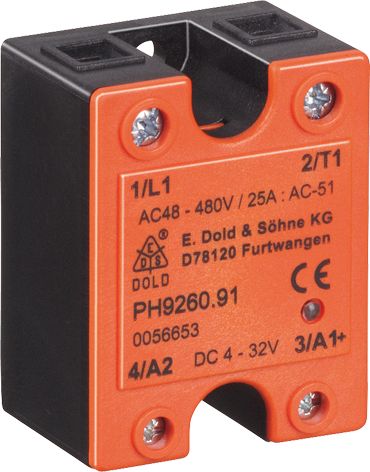
Dold 0059749 PH9260.91 AC24-240V AC50A semiconductor relay
| Lieske Part No. | 1001331 |
|---|---|
| Mfg Part No | 0059749 |
| EAN-Code | 4030641597498 |
| Manufacturer | Dold |
| Here only | 59,56 EUR
70,88 EUR incl. VAT
|
Further information for Dold 0059749 PH9260.91 AC24-240V AC50A semiconductor relay
| Technical data | |
| Load current up to | 125 A |
| Load voltage up to | AC 600 V |
| Number of poles | 1-pole |
| On/Off Input Control | AC/DC, DC |
| Width | 45 mm |
| Type | PH 9260 |
| Variant | |
| Control voltage | AC/DC 100 - 240 V |
| Load current | AC 50 A |
| Load voltage | AC 24 - 240 V |
| Semiconductor output | 1-pole |
| Variant | Switching at zero crossing. Without heat sink |
Applications
This semiconductor relay is suitable for use in the plastics and rubber industry, injection moulding machines, packaging machines, soldering systems, and the food industry. It is particularly suited for applications requiring frequent switching without mechanical contact wear. The zero-voltage switching ensures gentle load control, which is important for sensitive machinery or to avoid current surges. Alternatively, a variant with peak-voltage switching operation is available, specifically developed for switching transformers to avoid high inrush current.
Functions and Features in Detail
The device features two anti-parallel connected thyristors responsible for the switching function. The DCB technology (Direct-Copper-Bonding process) ensures excellent heat transfer, reducing thermal stress and increasing reliability. The LED status indicator signals the state of the control input, allowing visual monitoring of operation. The terminals are designed as box terminals, enabling secure and easy connections. The device is supplied without a heatsink, although an optional heatsink is available for mounting on a DIN rail.
Technology Explained Simply
Zero-voltage switching means the relay does not switch immediately upon applying the control voltage, but only at the next zero crossing of the alternating voltage. This prevents arcing and reduces electromagnetic interference. The peak blocking voltage is 1200 V or 1600 V, depending on the version, and the insulation voltage is 4000 V, ensuring high electrical safety. The thermal resistance between the blocking layer and housing is 0.6 K/W, limiting the thermal stress on the component. The maximum blocking layer temperature is 125 °C, ensuring safe operation in industrial environments.
Compatibility and Accessories
The semiconductor relay is designed for load voltages up to AC 600 V and load currents up to 125 A. It can be used in various operating modes, with the AC-51 operating mode being typical for industrial applications. An optional over-temperature protection is available, activated by installing a temperature-limiting switch (e.g. UCHIYA type UP62–100) into a designated pocket on the underside. This shuts off the device if the heatsink temperature exceeds 100 °C. Additionally, a variant with reduced electromagnetic emission is available, suitable for sensitive electronic systems.
Mounting and Installation
The device has a width of 45 mm and is designed for mounting on a DIN rail. The terminals are designed for direct connection to cables. Mounting requires no additional tools, and the terminals are easily accessible. The operating temperature range is -20 °C to 40 °C, with storage up to 80 °C possible. The enclosure protection rating is IP40, and the terminal protection rating is IP20, ensuring shock protection.
Operational Advantages
The semiconductor relay offers a long service life due to wear-free switching, as there are no mechanical contacts. Zero-voltage switching reduces electromagnetic interference and protects sensitive loads. The LED indicator allows easy status monitoring. The DCB technology ensures efficient heat dissipation, increasing reliability during continuous operation. The device is designed for industrial environments and meets the requirements of standard IEC/EN 60947-4-3.

This is an offer of:
79279 Vörstetten
https://industry-electronics.com
Tel. 07666/88499-0
Fax. 07666/88499-111
Diesen Artikel finden Sie unter:
industry-electronics.com/artikel/1001331

Lieske Elektronik e.K.
Reutener Str. 1079279 Vörstetten
https://industry-electronics.com
Tel. 07666/88499-0
Fax. 07666/88499-111
Diesen Artikel finden Sie unter:
industry-electronics.com/artikel/1001331