
Dold 0059736 PH9260.91 AC24-240V AC125A semiconductor relay UH=DC3.5-32V
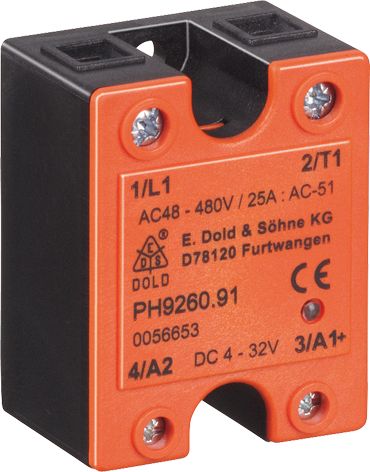
Dold 0059736 PH9260.91 AC24-240V AC125A semiconductor relay UH=DC3.5-32V
| Lieske Part No. | 1001352 |
|---|---|
| Mfg Part No | 0059736 |
| EAN-Code | 4030641597368 |
| Manufacturer | Dold |
| Here only | 105,31 EUR
125,32 EUR incl. VAT
|
Further information for Dold 0059736 PH9260.91 AC24-240V AC125A semiconductor relay UH=DC3.5-32V
| Technical data | |
| Load current up to | 125 A |
| Load voltage up to | AC 600 V |
| Number of poles | 1-pole |
| On/Off Input Control | AC/DC, DC |
| Width | 45 mm |
| Type | PH 9260 |
| Variant | |
| Control voltage | DC 3,5 - 32 V |
| Load current | AC 125 A |
| Load voltage | AC 24 - 240 V |
| Semiconductor output | 1-pole |
| Variant | Switching at zero crossing. Without heat sink |
Applications
This relay is intended for use in various industrial machines and plants, particularly in the plastics and rubber industry, packaging machines, soldering systems, and the food industry. It is suitable for switching heaters, motors, valves, and lighting systems. The zero-voltage switching ensures low electromagnetic emissions and avoids unwanted current surges during switching.
Functions and Features in Detail
The device features two antiparallel-connected thyristors responsible for the switching function. The DCB technology (Direct-Copper-Bonding process) ensures excellent heat transfer, increasing thermal load capacity. The LED status indicator signals the state of the control input. The terminals are designed as box terminals, enabling secure and easy connections. The device is equipped with a touch protection rating of IP20, representing a mechanical protection class for the connection terminals.
Technical Explanation
Switching is controlled via the control voltage applied to terminals A1/A2. When the control voltage is applied, the output activates at the next zero crossing of the mains voltage. When the control voltage is removed, the relay switches off at the next zero crossing of the load current. The peak blocking voltage is 1200 V or 1600 V, and the insulation voltage is 4000 V. The maximum load voltage is AC 600 V. Thermal load capacity is determined by the thermal resistance between the blocking layer and housing (0.6 K/W) and between the housing and ambient (12 K/W). The maximum blocking layer temperature is 125 °C.
Compatibility and Accessories
The relay complies with IEC/EN 60947-4-3 standards. It is available in a version without a heatsink, with an optional heatsink available for mounting on a DIN rail. For thermal protection, a temperature limit switch (normally open) can be inserted into a designated slot on the underside. As an example, the UCHIYA type UP62 – 100 temperature limit switch is mentioned, which opens the contact at 100 °C. An optional version with reduced electromagnetic emissions is also available.
Mounting and Installation
The device is designed for mounting on a DIN rail. The width is 45 mm. The operating temperature range is from -20 °C to 40 °C, and the storage temperature range is from -20 °C to 80 °C. Mechanical load capacity is defined by a vibration test standard according to IEC/EN 60068-2-6 with an amplitude of 0.35 mm and a frequency of 10 to 55 Hz. The housing is made of fiber-reinforced polycarbonate and is flame-retardant.
Operational Advantages
The relay provides wear-free operation without mechanical contacts, increasing service life and extending maintenance intervals. Zero-voltage switching reduces network interference and avoids current surges. The LED indicator allows for quick visual inspection of the operating status. The DCB technology ensures efficient heat dissipation, enhancing reliability under load conditions. Compliance with the IEC/EN 60947-4-3 standard ensures safety and reliability in industrial applications.

This is an offer of:
79279 Vörstetten
https://industry-electronics.com
Tel. 07666/88499-0
Fax. 07666/88499-111
Diesen Artikel finden Sie unter:
industry-electronics.com/artikel/1001352

Lieske Elektronik e.K.
Reutener Str. 1079279 Vörstetten
https://industry-electronics.com
Tel. 07666/88499-0
Fax. 07666/88499-111
Diesen Artikel finden Sie unter:
industry-electronics.com/artikel/1001352