
Dold 0059690 PH9260.91 semiconductor relay AC48-480V
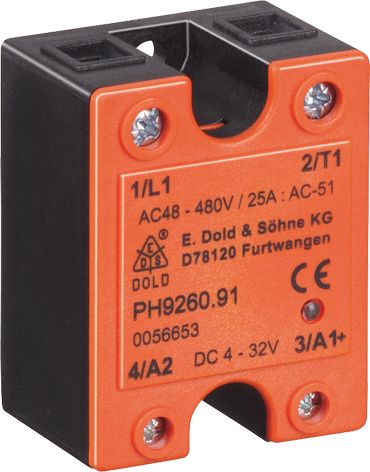
Dold 0059690 PH9260.91 semiconductor relay AC48-480V
| Lieske Part No. | 1001332 |
|---|---|
| Mfg Part No | 0059690 |
| EAN-Code | 4030641596903 |
| Manufacturer | Dold |
| Here only | 63,93 EUR
76,08 EUR incl. VAT
|
Further information for Dold 0059690 PH9260.91 semiconductor relay AC48-480V
| Technical data | |
| Load current up to | 125 A |
| Load voltage up to | AC 600 V |
| Number of poles | 1-pole |
| On/Off Input Control | AC/DC, DC |
| Width | 45 mm |
| Type | PH 9260 |
| Variant | |
| Control voltage | AC/DC 100 - 240 V |
| Load current | AC 25 A |
| Load voltage | AC 48 - 480 V |
| Semiconductor output | 1-pole |
| Variant | Switching at zero crossing. Without heat sink |
Applications
This semiconductor relay is suitable for applications in the plastics and rubber industry, injection moulding machines, packaging machines, soldering systems, and the food industry. It is particularly suitable for systems requiring frequent switching, as it has no mechanical contacts and therefore operates wear-free. The zero-voltage switching configuration is ideal for loads where soft switching on and off is important to avoid voltage spikes and interference.
Functions and Equipment in Detail
The device features two antiparallel-connected thyristors responsible for the switching function. The DCB technology (Direct-Copper-Bonding process) ensures excellent heat transfer, reducing thermal stress and increasing reliability. The box terminals allow for secure and easy connection of cables. An LED status indicator signals the state of the control input, enabling visual monitoring of the operating condition. The peak blocking voltage is 1200 V or 1600 V, and the insulation voltage is 4000 V, ensuring high electrical safety. The shock protection class is IP20, providing protection against contact with solid objects up to 12.5 mm in diameter.
Technology Explained Simply
The zero-voltage switching function means that the relay activates at the next zero crossing of the mains voltage as soon as the control voltage is applied. Switching off occurs at the next zero crossing of the load current. This prevents sparking and reduces electromagnetic interference. The DCB technology ensures that heat is efficiently dissipated from the semiconductor chip to the housing, extending the device’s lifespan. The combination of thyristors and DCB technology enables reliable and powerful switching performance.
Compatibility and Accessories
The semiconductor relay is available in standard configuration without a heatsink. Optionally, it can be supplied with a heatsink for DIN rail mounting, improving heat dissipation. An optional overtemperature protection can be integrated by inserting a temperature-limiting switch (normally open) into a designated slot on the underside. If the heatsink temperature exceeds, for example, 100 °C, the switch opens and protects the device. For thermal protection, a temperature-limiting switch of type UCHIYA UP62–100 can be used. The devices are also available in a peak-voltage switching variant, specifically suitable for switching transformers, as it avoids the high inrush current.
Mounting and Installation
Mounting is done on a DIN rail, with the width of 45 mm allowing for compact placement. The box terminals allow for secure and easy cable connections. Terminal designations are clearly defined: A1(+) and A2 for the control input, L1 for the mains connection, and T1 for the load output. Installation should take place in a protected environment, as the device is designed for operation at temperatures from -20 °C to 40 °C. Storage is permitted at -20 °C to 80 °C.
Operational Advantages
The semiconductor relay offers wear-free operation, as there are no mechanical contacts. The zero-voltage switching function reduces interference and extends the service life of connected loads. The LED indicator enables easy status monitoring. The DCB technology ensures efficient heat dissipation, increasing reliability. The high insulation voltage and peak blocking voltage ensure safe operation. The combination of robust design and high technical specifications makes the device a reliable solution for industrial applications.

This is an offer of:
79279 Vörstetten
https://industry-electronics.com
Tel. 07666/88499-0
Fax. 07666/88499-111
Diesen Artikel finden Sie unter:
industry-electronics.com/artikel/1001332

Lieske Elektronik e.K.
Reutener Str. 1079279 Vörstetten
https://industry-electronics.com
Tel. 07666/88499-0
Fax. 07666/88499-111
Diesen Artikel finden Sie unter:
industry-electronics.com/artikel/1001332