
Dold 0059455 RP5991S/100 DC24V expansion module
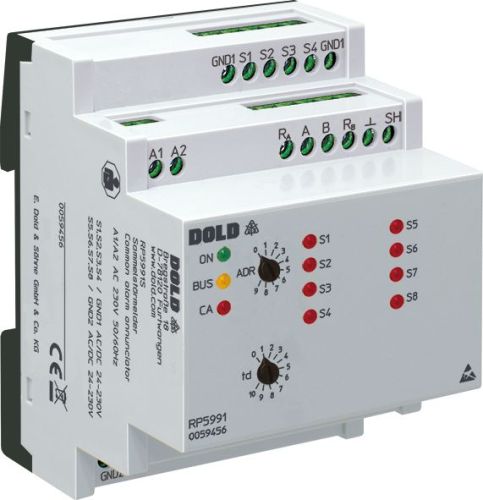
Dold 0059455 RP5991S/100 DC24V expansion module
| Lieske Part No. | 1002098 |
|---|---|
| Mfg Part No | 0059455 |
| EAN-Code | 4030641594558 |
| Manufacturer | Dold |
| Here only | 385,29 EUR
458,50 EUR incl. VAT
|
Further information for Dold 0059455 RP5991S/100 DC24V expansion module
| Technical data | |
| Alarm inputs | 8 |
| Alarm inputs extendable up to | 88 |
| Enclosure design | Distribution board |
| Operating principle | De-energized on trip, Energized on trip |
| Optical signal | LED |
| Special features | Bus-compatible, Configurable |
| Width | 70 mm |
| Type | RP 5991 |
| Operate delay | |
| Optional buzzer | |
| Variant | |
| Contact equipping | 2 x 1 NO contact |
| Nominal voltage | DC 24 V |
| Terminal type | screw terminal fixed |
| Variant | RS485 Bus isolated |
Applications
This module is used in industrial environments where rapid fault localization and reduction of production downtimes are required. It is particularly suitable for systems with multiple monitored components, where central fault notification is necessary. The expandability from 8 to 88 fault warning inputs allows flexible adaptation to different system sizes.
Functions and equipment in detail
The RP5991S/100 features 8 fault warning inputs, each equipped with an LED for optical signaling. The inputs can be operated in either current-on or current-off principle, with the setting adjusted on the base module via a rotary switch and on the expansion modules via bridge X1/X2. The response delay of the warning inputs is adjustable from 0 to 10 seconds, enabling filtering of short-term disturbances. Optionally, one relay each for collective warning and horn is available, as well as front-mounted reset buttons for horn and collective warning. Optical signaling is provided by LED indicators showing the status of individual inputs.
Technology explained simply
The device operates on the principle of a collective fault warning system, detecting faults from multiple inputs and displaying them centrally. The galvanic isolation of the RS485 bus (optional) enables secure data transmission between modules and a higher-level system, allowing faults to be monitored over longer distances. Configuration is performed via a configuration cycle, during which the address of each module is set, along with the current-on or current-off principle and the response delay. The front of the device displays status LEDs and allows direct acknowledgment of warnings.
Compatibility and accessories
The module is designed as an expansion module for the base module RP 5990 and can be used in combination with warning panels EH 5990 and EH 5991. The warning panels provide visual display of faults and can optionally be equipped with reset buttons. Additionally, an alarm generator RK 8832 is available to support acoustic warnings. The modules are connected via a galvanically isolated RS485 bus, ensuring reliable communication.
Mounting and installation
The device is installed in an installation distributor, with its width of 70 mm enabling standard mounting. Wiring is done via fixed screw terminals, ensuring a secure electrical connection. Configuration is performed after wiring via the configuration cycle, during which the address, response principle, and delay setting are configured. The front of the device has a protection rating of IP 64, providing a high level of protection against dust and water.
Advantages in operation
Central detection and display of faults enable rapid fault localization and reduce production downtimes. The device’s configurability regarding response principle, delay, and address offers flexibility in adapting to different requirements. Galvanic isolation of the bus increases interference immunity and communication reliability. Optical signaling via LED indicators and the ability to acknowledge warnings directly on the device improve system operability and clarity.
Collective fault warning system, fault warning inputs, RS485 bus, galvanically isolated, current-on principle, current-off principle

This is an offer of:
79279 Vörstetten
https://industry-electronics.com
Tel. 07666/88499-0
Fax. 07666/88499-111
Diesen Artikel finden Sie unter:
industry-electronics.com/artikel/1002098

Lieske Elektronik e.K.
Reutener Str. 1079279 Vörstetten
https://industry-electronics.com
Tel. 07666/88499-0
Fax. 07666/88499-111
Diesen Artikel finden Sie unter:
industry-electronics.com/artikel/1002098