
Dold 0059328 semiconductor contactor AC24-480V
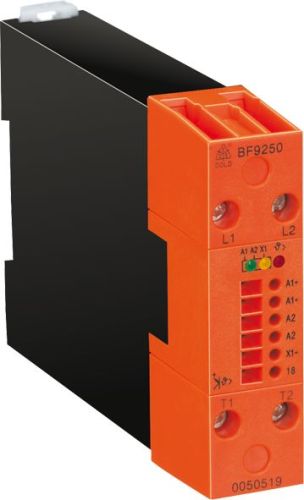
Dold 0059328 semiconductor contactor AC24-480V
| Lieske Part No. | 1001417 |
|---|---|
| Mfg Part No | 0059328 |
| EAN-Code | 4030641593285 |
| Manufacturer | Dold |
| Here only | 269,56 EUR
320,78 EUR incl. VAT
|
Further information for Dold 0059328 semiconductor contactor AC24-480V
| Technical data | |
| Approvals | UL |
| Load current up to | 50 A |
| Load voltage up to | AC 480 V |
| Number of poles | 1-pole, 2-pole, 3-pole |
| On/Off Input Control | AC/DC, DC |
| Width | 22,5 mm, 45 mm, 90 mm |
| Type | BF 9250 |
| Signalling output | |
| Temperature monitoring | |
| Variant | |
| Auxiliary voltage | AC/DC 110 - 230 V |
| Contact equipping | with signal contact |
| Load current | AC 50 A |
| Load voltage | AC 24 - 480 V |
| Semiconductor output | 1-pole |
| Approvals and Markings | UL-listed C/US |
| Variant | Switching at zero crossing. |
Applications include all uses requiring contactless, wear-free, and interference-free switching. It is particularly suitable for installations where mechanical relays or contactors are no longer sufficient due to wear, noise, or high switching frequencies. The temperature monitoring of the power semiconductor protects the device from overheating and ensures increased operational safety. In case of overheating, an alarm output is activated, signaling a fault via an open contact (11/12) or via terminal 18. This enables early response during operation, for example, by switching off or triggering an alarm.
Functions and equipment in detail include an integrated protection circuit using varistors, protecting the device against overvoltage. Temperature monitoring is optionally available and can be activated as needed. Control is via terminals A1/A2, with an optional control input X1 with low current consumption available, suitable for control via a PLC (Programmable Logic Controller). The LED indicators (green for operating voltage, yellow for X1 control, red for temperature alarm) allow visual monitoring of the operating status.
Technology explained simply is based on semiconductor technology, where thyristors or triacs serve as switching elements. Unlike mechanical contacts, there is no mechanical wear, ensuring high service life and reliability. Zero-voltage switching ensures that switching occurs at the zero crossing of the alternating voltage, minimizing current surges and electromagnetic interference. The integrated temperature monitoring monitors the heat development of the semiconductor and switches off if a critical value is exceeded, preventing damage.
Compatibility and accessories include the ability to use the device in various configurations (1-, 2-, and 3-pole). The width of 22.5 mm allows installation in standard control panels. Control via X1 makes it compatible with PLC systems. Certification according to IEC/EN 60947-4-2 and IEC/EN 60947-4-3, as well as UL listing (C/US), confirms compliance with international safety and quality standards. The devices are designed for use in industrial environments and can be used in combination with other semiconductor contactors of type BF 9250 or BH 9250.
Mounting and installation is done by snapping onto a DIN rail, enabling quick and secure fastening. The terminals are clearly labeled (A1, A2, X1, 18, 11, 12, L1, L2, L3, T1, T2, T3), simplifying wiring. The connection terminals are designed for use with cables matching the respective current and voltage ratings. Installation is carried out in a closed enclosure, ensuring that ambient temperature and ventilation do not impair operation.
Advantages in operation include high service life, noiseless switching, low maintenance, and high reliability. Temperature monitoring and the alarm output increase operational safety and enable proactive maintenance. Zero-voltage switching reduces electromagnetic interference and extends the life of connected loads. The device is suitable for use in industrial installations, building technology, and automation systems where a reliable and low-maintenance switching solution is required.

This is an offer of:
79279 Vörstetten
https://industry-electronics.com
Tel. 07666/88499-0
Fax. 07666/88499-111
Diesen Artikel finden Sie unter:
industry-electronics.com/artikel/1001417

Lieske Elektronik e.K.
Reutener Str. 1079279 Vörstetten
https://industry-electronics.com
Tel. 07666/88499-0
Fax. 07666/88499-111
Diesen Artikel finden Sie unter:
industry-electronics.com/artikel/1001417