
Dold 0058715 MK9055N.12 1-120000IPM AC230V+DC24V speed monitor
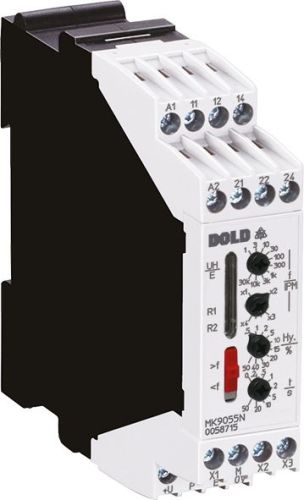
Dold 0058715 MK9055N.12 1-120000IPM AC230V+DC24V speed monitor
| Lieske Part No. | 1000884 |
|---|---|
| Mfg Part No | 0058715 |
| EAN-Code | 4030641587154 |
| Manufacturer | Dold |
| Here only | 255,65 EUR
304,22 EUR incl. VAT
|
Further information for Dold 0058715 MK9055N.12 1-120000IPM AC230V+DC24V speed monitor
| Technical data | |
| Classification | Drehzahlüberwachung |
| Enclosure design | Switch cabinet |
| Measuring range max. | 120000 IPM |
| Output contacts | 2 C/O contacts |
| Width | 22,5 mm |
| Type | MK 9055N |
| Variant | |
| Auxiliary voltage | AC 230 V + DC 24 V |
| Contact equipping | 2 changeover contacts |
| Response value | 1 - 120000 IPM |
| Terminal type | screw terminals fixed |
| Approvals and Markings | UKCA |
| Variant | Universal input, for configuration of different sensors (PNP, NPN, 2-wire, contact, voltage). Start up delay adjustable logarithmically |
Applications
The MK9055N.12 is designed for use in industrial automation technology. It is used for monitoring drives, rotating machine parts, cyclic lifting movements, and oscillations. Additional application areas include monitoring pulse sequences in conveying, transport, and production technology, as well as pulse frequency monitoring with sensors such as flow meters or anemometers. The device class speed monitoring makes it particularly suitable for installations where precise speed control is critical for process safety.
Functions and Equipment in Detail
The device features a universal input, configurable for various sensor types, including PNP, NPN, 2-wire, contact, and voltage signals. When using NAMUR sensors, sensor and wiring monitoring for disconnection and short circuit is possible. The adjustment ranges are divided into 10 steps, with the maximum measurement range reaching 120,000 IPM. The hysteresis is adjustable between 0.5 and 50 % to avoid false alarms due to minor fluctuations. The start-up bypass time can be set from 0 to 50 seconds and can be controlled externally via a contact. Additionally, monitoring for missing input signal in the overspeed function can be activated, which can also be used as an additional standstill threshold.
Technology Explained Simply
Signal processing is done by measuring the pulse period duration, enabling fast response even at low speeds. The auxiliary voltage can be supplied via terminals A1–A2 with AC 230 V or alternatively via +U / 0 V with DC 24 V. The output contacts consist of 2 changeover contacts operating on the de-energized relay principle, where the relay drops out in the alarm state. Programming is done via terminals: here, an alarm delay of 0 to 100 seconds, alarm memory, or auto-reset can be set. Status indicators are provided by LEDs for auxiliary voltage, input signal, and output relay; for NAMUR input, an additional LED for wiring or sensor fault is available.
Compatibility and Accessories
The device is designed for use with various sensor types, including NAMUR sensors. It can be combined with other devices from the VARIMETER series, such as the MH 9055, which offers an extended voltage range for auxiliary voltage. The devices are available in two housing forms: MK 9055N with a width of 22.5 mm and MH 9055 with 45 mm.
Mounting and Installation
The speed monitor is designed for installation in enclosures. Mounting is done via fixed screw terminals, ensuring a secure connection. Terminal designations are clearly defined: A1–A2 for auxiliary voltage, input for sensor inputs, X1–X3 for programming terminals, M as reference point, and output relay terminals 11–14 and 21–24. The devices comply with the standard IEC/EN 60255-1 and carry the UKCA mark.
Advantages in Operation
The universal input configuration and extensive adjustment options provide high flexibility in application. The fast response at low speeds and the ability to monitor signals increase reliability. The LED indicators enable quick diagnosis of the operating status. The combination of AC 230 V and DC 24 V as auxiliary voltage in one device increases application flexibility in different system configurations. The width of 22.5 mm ensures compact placement in the enclosure.

This is an offer of:
79279 Vörstetten
https://industry-electronics.com
Tel. 07666/88499-0
Fax. 07666/88499-111
Diesen Artikel finden Sie unter:
industry-electronics.com/artikel/1000884

Lieske Elektronik e.K.
Reutener Str. 1079279 Vörstetten
https://industry-electronics.com
Tel. 07666/88499-0
Fax. 07666/88499-111
Diesen Artikel finden Sie unter:
industry-electronics.com/artikel/1000884