
Dold 0058677 PH9260.91 AC48-600V AC100A semiconductor relay UH=DC4-32V
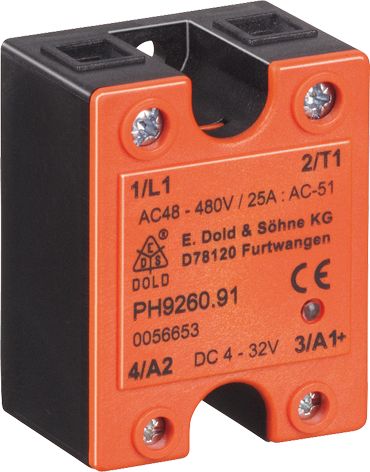
Dold 0058677 PH9260.91 AC48-600V AC100A semiconductor relay UH=DC4-32V
| Lieske Part No. | 1001359 |
|---|---|
| Mfg Part No | 0058677 |
| EAN-Code | 4030641586775 |
| Manufacturer | Dold |
| Here only | 101,97 EUR
121,34 EUR incl. VAT
|
Further information for Dold 0058677 PH9260.91 AC48-600V AC100A semiconductor relay UH=DC4-32V
| Technical data | |
| Load current up to | 125 A |
| Load voltage up to | AC 600 V |
| Number of poles | 1-pole |
| On/Off Input Control | AC/DC, DC |
| Width | 45 mm |
| Type | PH 9260 |
| Variant | |
| Control voltage | DC 4 - 32 V |
| Load current | AC 100 A |
| Load voltage | AC 48 - 600 V |
| Semiconductor output | 1-pole |
| Variant | Switching at zero crossing. Without heat sink |
Applications
This relay is suitable for use in machine building, plastic and rubber industry, packaging technology, soldering systems, and the food industry. It is particularly suited for applications requiring frequent switching without mechanical contact wear. The zero-voltage switching function ensures a gentle switching process, minimizing network disturbances and extending the service life of the loads. The version without a heatsink is designed for standard applications where the thermal load during operation does not exceed the cooling capacity.
Functions and Equipment in Detail
The device operates using two antiparallel-connected thyristors responsible for the switching function. The zero-voltage switching means that the relay activates at the next zero crossing of the sinusoidal supply voltage when the control voltage is applied. When switching off, the transition also occurs at the next zero crossing of the load current, ensuring minimal network disturbance. The integrated LED status indicator signals the state of the control input, facilitating diagnostics during operation. The box terminals allow for secure and easy connection of wires.
Technology Explained Simply
The DCB technology (Direct-Copper-Bonding process) ensures excellent heat transfer from the semiconductor to the housing, reducing thermal stress and increasing reliability. The peak blocking voltage is 1200 V or 1600 V, depending on the version, and the insulation voltage is 4000 V, ensuring high electrical safety. The shock protection class IP20 at the terminals protects against contact with conductive parts. The maximum limit load integral (I²t) is 18000 A²s, describing the relay’s ability to handle short-term overloads under AC-51 conditions.
Compatibility and Accessories
The relay is available as a standard version without a heatsink. Optional versions with a heatsink for DIN rail mounting are available, providing improved heat dissipation. An over-temperature protection can be optionally integrated by inserting a temperature limit switch (normally open) into a designated slot on the underside. If the temperature exceeds 100 °C, the switch opens and protects the device. For use in environments with increased electromagnetic interference, a version with reduced HF emission is available.
Mounting and Installation
Mounting is done on standard DIN rail. The terminals are designed for connection with cables, with designations L1 (supply connection), T1 (load output), and A1/A2 (control input). The operating temperature range is from -20 °C to +40 °C, and the storage temperature range is from -20 °C to +80 °C. The mechanical durability is designed for vibrations with an amplitude of 0.35 mm and frequencies from 10 to 55 Hz.
Advantages in Operation
The relay offers wear-free operation, extending maintenance intervals. The noiseless switching is particularly advantageous in sensitive environments. The high insulation strength and robust construction made of fiber-reinforced polycarbonate ensure a long service life. The LED indicator simplifies fault diagnosis. Compliance with the standard IEC/EN 60947-4-3 ensures reliability in industrial applications. Operational safety is supported by integrated heat dissipation and optional over-temperature protection function.

This is an offer of:
79279 Vörstetten
https://industry-electronics.com
Tel. 07666/88499-0
Fax. 07666/88499-111
Diesen Artikel finden Sie unter:
industry-electronics.com/artikel/1001359

Lieske Elektronik e.K.
Reutener Str. 1079279 Vörstetten
https://industry-electronics.com
Tel. 07666/88499-0
Fax. 07666/88499-111
Diesen Artikel finden Sie unter:
industry-electronics.com/artikel/1001359