
Dold 0058664 semiconductor contactor AC230-480V AC25A
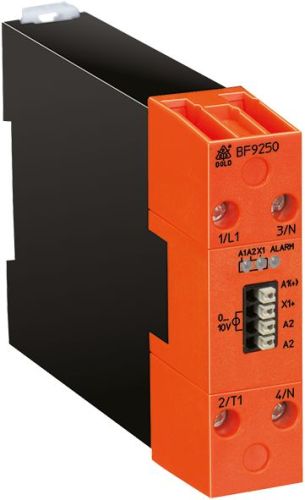
Dold 0058664 semiconductor contactor AC230-480V AC25A
| Lieske Part No. | 1001523 |
|---|---|
| Mfg Part No | 0058664 |
| EAN-Code | 4030641586645 |
| Manufacturer | Dold |
| Here only | 235,00 EUR
279,65 EUR incl. VAT
|
Further information for Dold 0058664 semiconductor contactor AC230-480V AC25A
| Technical data | |
| Analog Input Control | 4 - 20 mA |
| Approvals | UL |
| Load current up to | 50 A |
| Load voltage up to | AC 480 V |
| Number of poles | 1-pole |
| Width | 22,5 mm, 45 mm, 90 mm |
| Type | BF 9250/0_2 |
| Temperature monitoring | |
| Variant | |
| Auxiliary voltage | AC/DC 24 V |
| Contact equipping | without signal contact |
| Control input | DC 4 - 20 mA |
| Load current | AC 25 A |
| Load voltage | AC 230 - 480 V |
| Semiconductor output | 1-pole |
| Approvals and Markings | UL-listed C/US |
| Variant | Output control with fixed period of 64 cycles |
Applications
This device is specifically designed for controlling resistive loads such as heaters, heating radiators, or infrared lamps. It is suitable for applications requiring precise temperature control, for example in the packaging industry, food processing, or chemical industry. The zero-voltage switching function ensures disturbance-free switching, as the load circuit is closed only at the zero crossing of the mains voltage, minimizing spark generation and electromagnetic interference.
Functions and Equipment in Detail
Control is performed via an analog input, which can be configured as a current input (DC 4–20 mA), voltage input (DC 0–10 V), or potentiometer input (0–10 kΩ). Inverted analog inputs are also possible. Pulse-width control is achieved through a linear distribution of pulses over 64 cycles, providing a high resolution of 1.5625 %. This allows fine adjustment of output power to the desired temperature. LED indicators display the operating status: green LED for auxiliary voltage, yellow LED for output status, and red LED for alarms. The red LED lights up in case of synchronization errors, control input faults, or overheating of the power semiconductor, with the overheating alarm being latched and requiring a brief interruption of the supply voltage to reset.
Technology Explained Simply
The device operates as a semiconductor contactor, i.e., without mechanical contacts, ensuring high service life and low maintenance frequency. Control is performed by an integrated controller that processes the input signal and adjusts the pulse width of the output signal accordingly. Zero-voltage detection ensures that the load circuit is only closed at the zero crossing of the mains voltage, increasing the lifespan of the semiconductors and minimizing network disturbances. A varistor protects the device against overvoltage, and a temperature protection for the power semiconductor prevents damage in case of overheating. The operating temperature ranges from 0 to 40 °C, with current derating occurring above 40 °C (0.2 A/°C at 10 A, 0.4 A/°C at 25 A, 0.6 A/°C at 50 A).
Compatibility and Accessories
The device complies with IEC/EN 60947-4-2 and IEC/EN 60947-4-3 standards and carries the UL certification C/US. It is designed for DIN rail mounting and can be integrated into enclosures or control systems. The load is resistive, allowing use with heating elements, heating radiators, or other resistive loads. The maximum I²t value for fuse protection is 800 A²s for 10 A and 25 A, and 1800 A²s for 50 A, supporting the selection of appropriate fuses.
Mounting and Installation
The device is mounted on a DIN rail, with the width varying according to the rated current. Recommended clearances to the surrounding environment are 20 mm above and below, and 10 mm to the right and left, to ensure sufficient cooling. Connections are made via terminals: A1 (+) and A2 (-) for auxiliary voltage, X1 for control input, L1/N for mains connections, and T1/N for load output. Installation is performed in a closed enclosure to control environmental conditions (temperature, humidity).
Advantages in Operation
The semiconductor contactor offers high switching accuracy and reliability through pulse-width control. Zero-voltage switching reduces electromagnetic interference and extends component lifespan. The integrated LED indicator enables quick diagnosis of operating states and faults. The temperature protection function safeguards the device against overheating, and the varistor protection circuit provides additional protection against voltage surges. Analog control allows precise temperature regulation, which is critical for many industrial processes.

This is an offer of:
79279 Vörstetten
https://industry-electronics.com
Tel. 07666/88499-0
Fax. 07666/88499-111
Diesen Artikel finden Sie unter:
industry-electronics.com/artikel/1001523

Lieske Elektronik e.K.
Reutener Str. 1079279 Vörstetten
https://industry-electronics.com
Tel. 07666/88499-0
Fax. 07666/88499-111
Diesen Artikel finden Sie unter:
industry-electronics.com/artikel/1001523