
Dold 0058266 GB9034 600A AC50/60Hz 400V motor brake unit
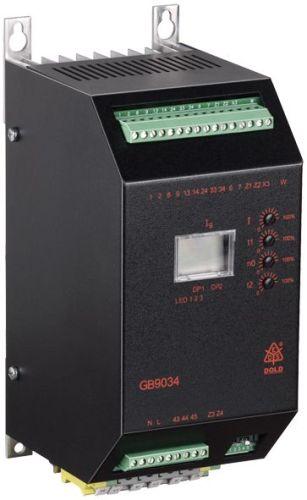
Dold 0058266 GB9034 600A AC50/60Hz 400V motor brake unit
| Lieske Part No. | 1001880 |
|---|---|
| Mfg Part No | 0058266 |
| EAN-Code | 4030641582661 |
| Manufacturer | Dold |
| Here only | 6.726,12 EUR
8.004,08 EUR incl. VAT
|
Further information for Dold 0058266 GB9034 600A AC50/60Hz 400V motor brake unit
| Technical data | |
| Braking current adjustable up to max. | 600 A |
| Braking time adjustable up to max. | 320 s |
| Width | 110 mm |
| Type | GB 9034 |
| Automatic standstill monitoring | |
| External brake contactor required | |
| Signalling output | |
| Temperature monitoring | |
| Variant | |
| Auxiliary voltage | Without |
| Braking current | 600 A |
| Nominal voltage | AC 400 V |
| Approvals and Markings | UKCA |
Applications
The motor brake device is designed for industrial applications where rapid and secure stopping of the motor is required. It is particularly suitable for systems where short coast-down times contribute to improved productivity and safety. The integrated automatic standstill monitoring ensures that the motor comes to a stop within the set braking time. If standstill is not achieved, a fault message is triggered via a potential-free signaling contact, enabling monitoring of the braking process.
Functions and Equipment in Detail
The device features integrated temperature monitoring, which detects overheating in the motor or heat sink and responds accordingly. Braking is performed via an external brake contactor, which is controlled via terminals 1 and 2. The time coordination between switching off the motor contactor and switching on the brake contactor ensures that short-term induction voltages do not damage the power section. Braking is initiated by controlling the external brake contactor, with the braking current flowing to the stator winding of the motor via terminals U and V.
Technology Explained Simply
DC braking works by converting alternating voltage into direct voltage via a single-phase rectifier, which then flows through the stator winding of the motor. This generates a braking torque that allows the motor to be braked in a controlled manner. The braking time and braking current are adjustable to adapt the braking characteristics to the specific requirements of the motor and system. The automatic standstill monitoring supervises the motor during the braking phase and switches off the braking current as soon as the motor has stopped. This prevents unnecessary energy losses and protects the motor from overheating.
Compatibility and Accessories
The device is suitable for all asynchronous motors and complies with the standard IEC/EN 60947-4-2. It is designed for a nominal voltage of AC 400 V and requires an external brake contactor, as the brake contactor is not integrated in devices with a braking current exceeding 60 A. The width is 110 mm, enabling compact installation in enclosures. The UKCA approval is granted, allowing use in relevant markets.
Mounting and Installation
Installation is carried out by connecting the supply voltage to L1 and L2 and the motor connections to U, V and W. The interlock contacts for the motor contactor (terminals 8-9) and the external brake contactor (terminals 1-2) must be connected according to the wiring diagram instructions. The ready LED indicates that the supply voltage is present and the device is operational. The adjustment of braking time and braking current is performed using the designated adjustment options on the device.
Advantages in Operation
Due to its wear-free and maintenance-free operation, the device reduces maintenance costs and increases operational safety. Shorter coast-down times improve productivity and allow for faster restart after a stop. The integrated standstill monitoring and signaling output ensure reliable monitoring of the braking process, which is particularly advantageous in safety-critical applications. The simple integration into existing systems facilitates installation and commissioning.

This is an offer of:
79279 Vörstetten
https://industry-electronics.com
Tel. 07666/88499-0
Fax. 07666/88499-111
Diesen Artikel finden Sie unter:
industry-electronics.com/artikel/1001880

Lieske Elektronik e.K.
Reutener Str. 1079279 Vörstetten
https://industry-electronics.com
Tel. 07666/88499-0
Fax. 07666/88499-111
Diesen Artikel finden Sie unter:
industry-electronics.com/artikel/1001880