
Dold 0058255 semiconductor contactor AC24-240V AC25A
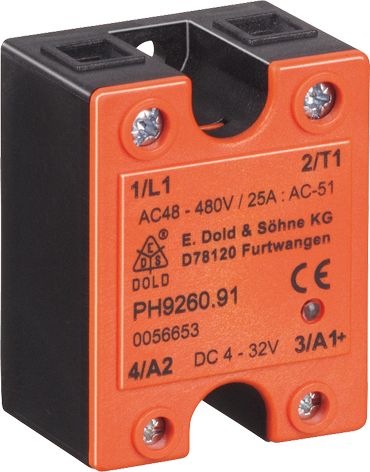
Dold 0058255 semiconductor contactor AC24-240V AC25A
| Lieske Part No. | 1001549 |
|---|---|
| Mfg Part No | 0058255 |
| EAN-Code | 4030641582555 |
| Manufacturer | Dold |
| Here only | 91,77 EUR
109,21 EUR incl. VAT
|
Further information for Dold 0058255 semiconductor contactor AC24-240V AC25A
| Technical data | |
| Load current up to | 125 A |
| Load voltage up to | AC 600 V |
| Number of poles | 1-pole |
| On/Off Input Control | AC/DC, DC |
| Width | 45 mm |
| Type | PH 9260 |
| Variant | |
| Control voltage | AC/DC 100 - 240 V |
| Load current | AC 25 A |
| Load voltage | AC 24 - 240 V |
| Semiconductor output | 1-pole |
| Variant | Switching at zero crossing. With heat sink |
Applications include particularly machines in the plastics and rubber industry, such as injection moulding machines, as well as packaging machines, soldering systems, and food industry equipment. Zero-voltage switching is especially suitable for applications requiring gentle switching and low-noise operation. Alternatively, the device is also available in a peak-voltage switching variant, specifically designed for switching transformers to avoid high inrush currents.
Functions and equipment in detail include two antiparallel-connected thyristors providing the switching function. The DCB technology (Direct-Copper-Bonding process) ensures excellent heat transfer, reducing thermal stress on the device. An integrated heat sink allows mounting on a DIN rail and ensures optimal cooling. The LED status indicator signals the status of the control input. The terminals are designed as box terminals, enabling secure and easy connections. The degree of protection is IP20, providing protection against contact with fingers or similar objects.
Technology explained simply shows that the device features high insulation strength: the insulation voltage is 4000 V, and the peak blocking voltage is 1200 V or 1600 V. The maximum load voltage is AC 600 V, and the maximum load current is 125 A, with the rated load current at AC 25 A. The device is designed for continuous operation and can be operated in a temperature range from -20 °C to 40 °C. Thermal resistances are specified as 0.6 K/W (junction-to-case) and 12 K/W (case-to-ambient), highlighting the device’s thermal performance. The limit load integral (I²t) is up to 18000 A²s, demonstrating the device’s ability to handle short-term overloads.
Compatibility and accessories include the option to combine the device with an over-temperature protection. For this, a temperature limit switch (normally open) can be inserted into a designated slot at the bottom of the device. If a predefined temperature, for example 100 °C, is exceeded, the switch opens and protects the device from thermal overload. An example is the temperature limit switch UCHIYA type UP62–100. Additionally, a variant with reduced electromagnetic interference is available, which is advantageous for sensitive electronic systems.
Mounting and installation is done via the DIN rail, with the heat sink snap-fitting into place. The width is 45 mm, enabling compact installation in enclosures. Terminal marking follows the standard: A1(+)/A2 for the control input, L1 for the mains connection, and T1 for the load output. Mounting requires no additional tools, as the terminals can be directly screwed in.
Operational advantages include wear-free switching, ensuring high service life and low maintenance. Zero-voltage switching reduces electromagnetic interference and prevents mechanical stress. The integrated LED indicator allows for quick visual inspection of the operating status. The DCB technology and heat sink ensure efficient heat dissipation, increasing the device’s reliability in continuous operation. Compliance with the standard IEC/EN 60947-4-3 ensures safe and standard-compliant integration into industrial control systems.

This is an offer of:
79279 Vörstetten
https://industry-electronics.com
Tel. 07666/88499-0
Fax. 07666/88499-111
Diesen Artikel finden Sie unter:
industry-electronics.com/artikel/1001549

Lieske Elektronik e.K.
Reutener Str. 1079279 Vörstetten
https://industry-electronics.com
Tel. 07666/88499-0
Fax. 07666/88499-111
Diesen Artikel finden Sie unter:
industry-electronics.com/artikel/1001549