
Dold 0057428 BF9250.93/008 semiconductor contactor 3xAC10A
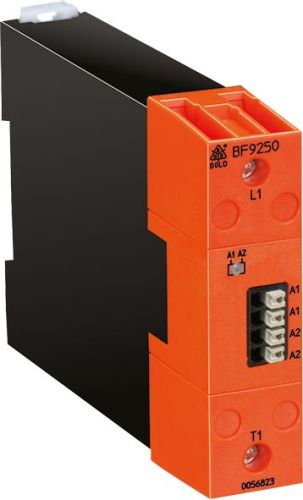
Dold 0057428 BF9250.93/008 semiconductor contactor 3xAC10A
| Lieske Part No. | 100141 |
|---|---|
| Mfg Part No | 0057428 |
| EAN-Code | 4030641574284 |
| Manufacturer | Dold |
| Here only | 253,38 EUR
301,52 EUR incl. VAT
|
Further information for Dold 0057428 BF9250.93/008 semiconductor contactor 3xAC10A
| Technical data | |
| Approvals | UL |
| Load current up to | 50 A |
| Load voltage up to | AC 480 V |
| Number of poles | 1-pole, 2-pole, 3-pole |
| On/Off Input Control | DC |
| Width | 22,5 mm, 45 mm, 90 mm |
| Type | BF 9250/_ _8 |
| Variant | |
| Auxiliary voltage | DC 9 - 32 V |
| Contact equipping | without signal contact |
| Load current | 3 x AC 10 A |
| Load voltage | AC 24 - 240 V |
| Semiconductor output | 3-pole |
| Approvals and Markings | UL-listed C/US |
| Variant | Switching at zero crossing. |
Applications
This semiconductor contactor is designed for use in systems for automated control of heating, motors, valves, and lighting. It is especially suitable for applications where a mechanical relay or contactor is no longer appropriate due to switching noise, wear, or limited service life. The noiseless switching and high switching frequency make it a reliable alternative in continuously operating systems.
Functions and Equipment in Detail
The device features a semiconductor output with 3-pole configuration, enabling it to switch three separate load circuits simultaneously. Control is achieved via a digital input interface with DC actuation. The turn-on and turn-off delay is each ≤ 1 ms plus 1/2 period of the supply voltage, with the 1/2 period being omitted in the instant-switching variant (not applicable to this model). The protection circuitry using varistors ensures increased immunity to interference and protects the device against transient voltage spikes. The green LED indicates that operating voltage is present at terminals A1/A2.
Technology Explained Simply
The BF9250.93/008 operates as an electronic switching device (semiconductor contactor) that has no moving contacts, instead switching the load via thyristors or triacs. This eliminates mechanical wear and switching noise. The zero-voltage switching function minimizes energy discharge during switching and reduces electromagnetic compatibility (EMC) in the system. The load voltage up to AC 480 V and load current up to 50 A (at smaller widths and lower temperatures) demonstrate the device’s performance capability. The current derating starting at 40 °C is 0.2 A/°C for 3-pole devices, meaning the maximum load current must be reduced accordingly at higher temperatures to limit thermal stress.
Compatibility and Accessories
The device is compliant with IEC/EN 60947-4-2 and IEC/EN 60947-4-3 and carries the UL-listed C/US approval, enabling use in the USA and Canada. It is clip-on mountable onto a DIN rail, allowing easy installation in enclosures. As accessories, semiconductor fuses (e.g. cylindrical fuse 10 x 38) are available, configured for 1-, 2-, or 3-pole versions with different rated currents (e.g. 10 A, 25 A, 50 A). The varistor voltage is AC 510 V, ensuring protection against overvoltages.
Mounting and Installation
Mounting is done by clipping onto a DIN rail. The installation position is horizontal, with the cooling fins oriented vertically to ensure optimal heat dissipation. The operating temperature range is 0 to 40 °C, with a maximum temperature of 60 °C (with current derating). Storage is possible in the range of -20 to +80 °C. The connection terminals are clearly labeled: A1/A2 for control voltage, L1/L2/L3 for supply connections, and T1/T2/T3 for load outputs.
Advantages in Operation
The device offers high service life due to the absence of mechanical contacts, noiseless switching, and high switching frequency. The EMC compliance according to IEC/EN 61000-6-4 and -6-1, along with protection measures against ESD, high-frequency radiation, and fast transients, ensures reliable operation in electrically demanding environments. The continuous operation capability and low power loss (calculated as P = 1.2 [V] x I_eff. [A] / k [W], where k = 1.11 for sinusoidal current) make it an energy-efficient component. The compatibility with semiconductor fuses enables additional protection for load circuits.

This is an offer of:
79279 Vörstetten
https://industry-electronics.com
Tel. 07666/88499-0
Fax. 07666/88499-111
Diesen Artikel finden Sie unter:
industry-electronics.com/artikel/100141

Lieske Elektronik e.K.
Reutener Str. 1079279 Vörstetten
https://industry-electronics.com
Tel. 07666/88499-0
Fax. 07666/88499-111
Diesen Artikel finden Sie unter:
industry-electronics.com/artikel/100141