
Dold 0057426 BF9250.92/008 semiconductor contactor 2xAC25A
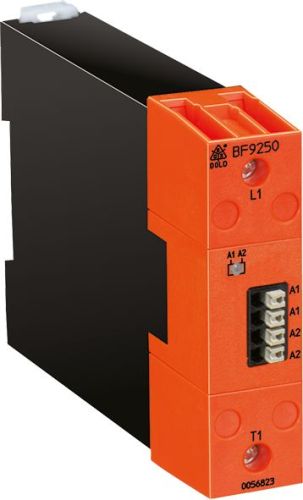
Dold 0057426 BF9250.92/008 semiconductor contactor 2xAC25A
| Lieske Part No. | 1001467 |
|---|---|
| Mfg Part No | 0057426 |
| EAN-Code | 4030641574260 |
| Manufacturer | Dold |
| Here only | 270,73 EUR
322,17 EUR incl. VAT
|
Further information for Dold 0057426 BF9250.92/008 semiconductor contactor 2xAC25A
| Technical data | |
| Approvals | UL |
| Load current up to | 50 A |
| Load voltage up to | AC 480 V |
| Number of poles | 1-pole, 2-pole, 3-pole |
| On/Off Input Control | DC |
| Width | 22,5 mm, 45 mm, 90 mm |
| Type | BF 9250/_ _8 |
| Variant | |
| Auxiliary voltage | DC 7 - 32 V |
| Contact equipping | without signal contact |
| Load current | 2 x AC 25 A |
| Load voltage | AC 24 - 480 V |
| Semiconductor output | 2-pole |
| Approvals and Markings | UL-listed C/US |
| Variant | Switching at zero crossing. |
Applications
This semiconductor contactor is designed for use in systems requiring frequent and disturbance-free switching of loads. Examples include heating systems, motors, valves, and lighting systems. Zero-voltage switching ensures that switching occurs at the zero crossing of the AC voltage, minimizing current surges and increasing the lifespan of both the load and the contactor. The device is intended for continuous operation at ambient temperatures from 0 to 40 °C, with a maximum operating temperature of 60 °C, at which point the current rating is reduced.
Functions and Features in Detail
The device features a semiconductor output designed for switching AC loads. Control is achieved via digital actuation with DC voltage. The turn-on and turn-off delay is each ≤ 1 ms plus 1/2 period, with the 1/2 period omitted in the instant-switching variant. The load voltage range is AC 24 to 480 V, with a frequency of 50/60 Hz. The minimum load current is AC 40 mA. The leakage current in the off state is approximately 1.0 mA. The peak blocking voltage is ± 1200 Vp.
Technology Explained Simply
The semiconductor contactor operates without mechanical contacts, minimizing noise emission and wear. Switching is performed via semiconductors activated by electronic control. Zero-voltage switching ensures switching occurs at the zero crossing of the AC voltage, preventing spark generation and current surges. Integrated protection circuitry using varistors safeguards the device against overvoltages. Power loss is calculated using the formula P = 1.2 [V] x Ieff. [A] / k [W], where k is the form factor and equals 1.11 for sinusoidal current.
Compatibility and Accessories
The device is available in various pole configurations (1-, 2-, and 3-pole) and can be integrated into different switching systems depending on width (22.5 mm, 45 mm, 90 mm). It is optionally available with a high I²t value for the semiconductor to handle high switching currents (variant /1_8). Protection measures include varistors and the use of semiconductor fuses, with a recommended fuse rating of 2 x 25 A for the 2-pole version. The terminal connections are designated for supply voltage (A1/A2), mains connections (L1, L2, L3), and load outputs (T1, T2, T3).
Mounting and Installation
Mounting is on DIN rail, with the installation position required to be horizontal. The cooling fins must be oriented vertically to ensure optimal heat dissipation. Storage is permitted in a temperature range of -20 to +80 °C. Creepage and clearance distances correspond to pollution degree 3 and a rated impulse withstand voltage of 4 kV according to IEC 60664-1.
Operational Advantages
The semiconductor contactor provides high operational reliability through zero-voltage switching, reducing stress on both the load and the device. The noiseless switching is particularly advantageous in sensitive environments. Integrated protection circuitry enhances reliability. DIN rail mounting allows for quick integration into existing switching systems. UL listing expands the application scope into international markets.

This is an offer of:
79279 Vörstetten
https://industry-electronics.com
Tel. 07666/88499-0
Fax. 07666/88499-111
Diesen Artikel finden Sie unter:
industry-electronics.com/artikel/1001467

Lieske Elektronik e.K.
Reutener Str. 1079279 Vörstetten
https://industry-electronics.com
Tel. 07666/88499-0
Fax. 07666/88499-111
Diesen Artikel finden Sie unter:
industry-electronics.com/artikel/1001467