
Dold 0056847 semiconductor contactor 3xAC 15A
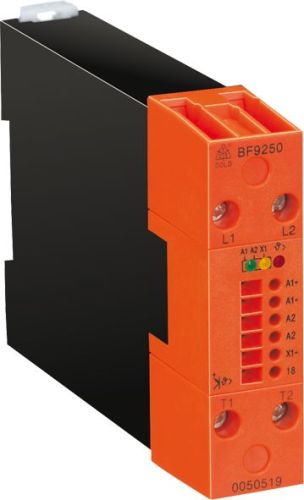
Dold 0056847 semiconductor contactor 3xAC 15A
| Lieske Part No. | 1001446 |
|---|---|
| Mfg Part No | 0056847 |
| EAN-Code | 4030641568474 |
| Manufacturer | Dold |
| Here only | 377,03 EUR
448,67 EUR incl. VAT
|
Further information for Dold 0056847 semiconductor contactor 3xAC 15A
| Technical data | |
| Approvals | UL |
| Load current up to | 50 A |
| Load voltage up to | AC 480 V |
| Number of poles | 1-pole, 2-pole, 3-pole |
| On/Off Input Control | AC/DC, DC |
| Width | 22,5 mm, 45 mm, 90 mm |
| Type | BF 9250 |
| Signalling output | |
| Temperature monitoring | |
| Variant | |
| Auxiliary voltage | AC/DC 110 - 230 V |
| Contact equipping | with signal contact |
| Load current | 3 x AC 15 A |
| Load voltage | AC 24 - 480 V |
| Semiconductor output | 3-pole |
| Approvals and Markings | UL-listed C/US |
| Variant | Switching at zero crossing. |
Applications
This semiconductor contactor is designed for use in systems controlling heating, motors, valves, and lighting. Due to its noiseless switching function, it is particularly suitable for applications requiring disturbance-free operation, such as in production plants, building technology, or automation systems. Zero-voltage switching reduces electromagnetic compatibility (EMC) interference and extends the service life of connected loads.
Functions and Equipment in Detail
The device features an integrated alarm output, which can be used to signal operating states or faults. Additionally, integrated temperature monitoring protects the power semiconductors and triggers a signal contact in case of overheating. The protection circuitry uses varistors to limit overvoltages during operation. Control is via a digital input capable of processing both AC/DC and DC signals. An optional control input X1 with low current consumption allows control via programmable logic controllers (PLCs). Indication is provided by LEDs: a green LED indicates supply voltage, a yellow LED signals control via X1, and a red LED lights up when temperature monitoring is activated.
Technology Explained Simply
The semiconductor contactor operates on the basis of power semiconductors that switch electrical loads without mechanical contacts. Unlike mechanical relays or contactors, wear and noise are eliminated. Zero-voltage switching ensures that the switch operates the load not at any arbitrary voltage, but precisely at the zero crossing of the alternating voltage. This minimizes sparking and network disturbances. The integrated temperature monitoring monitors the heat development of the semiconductors and switches off in case of overheating to prevent damage. Varistors protect the device from transient overvoltages, which may occur due to network disturbances or switching operations.
Compatibility and Accessories
The device complies with standards IEC/EN 60947-4-2 and IEC/EN 60947-4-3 and carries the UL-listed C/US certification. It is designed for use in electrical installations with AC loads up to 480 V and load currents up to 50 A. The width of 90 mm allows mounting on DIN rails in standard control panels. Variants with 22.5 mm and 45 mm widths are available, but are not part of this specific version. Control is via terminals A1/A2 or optionally via X1. Load connections are made via T1, T2, and T3.
Mounting and Installation
The semiconductor contactor is designed for mounting on DIN rails and can thus be directly integrated into existing control panels. The connection terminals are clearly labeled: A1/A2 for supply voltage, X1 for the optional control input, L1/L2/L3 for mains connections, and T1/T2/T3 for load outputs. The LED indicators support commissioning and maintenance by visually signaling the operating status. Installation is carried out in accordance with the relevant standards and electrical system planning.
Advantages in Operation
The device offers a long service life due to the absence of mechanical wear on contacts. Noiseless switching reduces operating noise in the system. Zero-voltage switching minimizes EMC interference and protects sensitive electronic loads. Integrated temperature monitoring increases operational safety, and varistors protect the device from voltage spikes. Control via PLC enables flexible integration into automation systems. DIN rail mounting simplifies installation and maintenance.

This is an offer of:
79279 Vörstetten
https://industry-electronics.com
Tel. 07666/88499-0
Fax. 07666/88499-111
Diesen Artikel finden Sie unter:
industry-electronics.com/artikel/1001446

Lieske Elektronik e.K.
Reutener Str. 1079279 Vörstetten
https://industry-electronics.com
Tel. 07666/88499-0
Fax. 07666/88499-111
Diesen Artikel finden Sie unter:
industry-electronics.com/artikel/1001446