
Dold 0056017 time relay delayed pickup AC230V
Industrial Material > Industrial relays and contactors > Industrial Timers
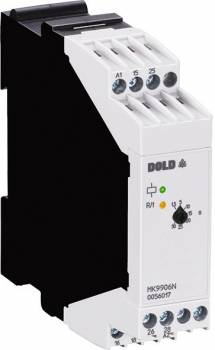
Dold 0056017 time relay delayed pickup AC230V
| Lieske Part No. | 466647 |
|---|---|
| Mfg Part No | 0056017 |
| EAN-Code | 4030641560171 |
| Manufacturer | Dold |
| Here only | 103,19 EUR
122,80 EUR incl. VAT
|
Further information for Dold 0056017 time relay delayed pickup AC230V
| Technical data | |
| Enclosure design | Switch cabinet |
| Output contacts | 2 C/O contacts |
| Time function(s) | On-delay |
| Width | 22,5 mm |
| Type | MK 9906N/600 |
| Variant | |
| Contact equipping | 2 changeover contacts |
| Nominal voltage | AC 230 V |
| Terminal type | screw terminals fixed |
| Time range | 1,5 - 30 s |
| Approvals and Markings | UKCA |
Applications
This device is designed for use in industrial control and switching systems, particularly in installations where time-controlled activation of components is required. Typical applications include controlling pumps, fans, lighting systems, or other electrical loads where immediate switching is not desired or technically inappropriate. Use in enclosures enables modular integration into existing systems.
Functions and Features in Detail
The time relay features a delayed-activation function, where the output is activated only after the set delay time has elapsed. The delay time can be continuously adjusted between 1.5 and 30 seconds using a rotary switch. Adjustment is made on an absolute scale, enabling precise and reproducible setting. The repeatability accuracy is ≤ ± 0.5 % of the scale end value, ensuring high accuracy in repeated switching operations.
For visual monitoring of the operating status, LED indicators are integrated: the upper LED lights up when operating voltage is applied, and the lower LED indicates when the output relay contact (15–18) is closed. This allows quick diagnosis of the operating status without additional measuring instruments.
Technology Explained Simply
The device operates at a rated voltage of AC 230 V, with a voltage range between 0.8 and 1.1 times the rated voltage. The drop-out voltage is 15 % of the rated voltage, ensuring reliable reset of the relay even during voltage fluctuations. The rated frequency is 50/60 Hz, with a tolerance range of ±5 %. The rated power consumption is 8.5 VA. The drop-out time of the output relay is 30 ms, enabling a quick response during switching off.
The output contacts consist of two changeover contacts (2 C/O), made from AgSnO₂ contact material. The rated operating voltage is AC 250 V. The relay can be loaded as a make contact up to 3 A at AC 230 V and as a break contact up to 1 A at AC 230 V. The electrical life is at least 500,000 switching operations at 3 A and AC 230 V, and the mechanical life exceeds 30 million switching operations. The permissible switching frequency is 6000 switching operations per hour.
Compatibility and Accessories
The device is suitable for use with two-wire initiators, enabling flexible control. The terminal type consists of fixed screw terminals, designed for conductor cross-sections of 2 x 1.5 mm² stranded wire with sleeve and plastic collar, or 2 x 2.5 mm² solid wire according to DIN 46228-1/-2/-3/-4. Optional plug-in terminal blocks are available, enabling quick device replacement. The width is 22.5 mm, allowing compact installation in standard enclosures.
Mounting and Installation
The device is designed for installation in enclosures and is connected via screw terminals. Mounting is carried out in an enclosure, with ambient temperature ranging from -20 °C to +60 °C. Storage is possible between -25 °C and +65 °C. Relative humidity at 40 °C must not exceed 93 %. The operating altitude is limited to a maximum of 2000 m above sea level.
Operational Advantages
The high repeatability accuracy and continuous adjustment of the delay time enable precise and reproducible control. The integrated LED indicators simplify commissioning and maintenance. The use of two changeover contacts offers flexibility in circuit design. The UKCA marking confirms compliance with applicable European safety and functional requirements. The overvoltage category III and insulation test voltage of 2.5 kV ensure high safety during installation in industrial environments.
Protection Rating and Environmental Conditions
The housing has a protection rating IP 40, providing dust and touch protection against solid foreign objects up to 1 mm. The terminals are protected to IP 20, offering protection against finger contact. The operating temperature range is -20 °C to +60 °C, and the storage temperature range is -25 °C to +65 °C. Relative humidity at 40 °C must not exceed 93 %. The operating altitude is limited to 2000 m.
EMC and Safety Requirements
The device meets the requirements of the EMC Directive and is designed for overvoltage category III. The test voltage is 2.5 kV for 1 minute. Radio frequency interference suppression complies with Class B according to EN 55011. Electrostatic discharge (ESD) is 8 kV (air discharge), and RF field strength is 10 V/m in the range 80 MHz to 2.7 GHz. Fast transients are 4 kV, and surge voltage between supply lines is 1 kV and between line and earth is 2 kV. Conducted RF interference is 10 V.
General Data
The device is designed for continuous operation. The width is 22.5 mm. The housing is made of thermoplastic with V0 flammability rating according to UL 94. Vibration resistance is tested according to DIN EN 60068-2-6. The insulation class is 2, and the rated impulse withstand voltage is 4 kV. The pollution degree is 2. The creepage distance and clearance meet the requirements of IEC/EN 60664-1.
Approvals and Markings
The device carries the UKCA marking, confirming compliance with applicable European safety and functional requirements. The standard EN 61812-1 for time relays is complied with. The overvoltage category III and insulation test voltage of 2.5 kV ensure high safety during installation in industrial environments.
Applications
The time relay is used in industrial controls to implement time-delayed switching operations. Examples include starting motors, controlling pumps or fans, time-controlled lighting, or coordinating process steps in manufacturing systems. The continuous adjustment of the delay time allows individual adaptation to specific requirements.

This is an offer of:
79279 Vörstetten
https://industry-electronics.com
Tel. 07666/88499-0
Fax. 07666/88499-111
Diesen Artikel finden Sie unter:
industry-electronics.com/artikel/466647

Lieske Elektronik e.K.
Reutener Str. 1079279 Vörstetten
https://industry-electronics.com
Tel. 07666/88499-0
Fax. 07666/88499-111
Diesen Artikel finden Sie unter:
industry-electronics.com/artikel/466647