
Dold 0055322 BI9028.38/001 soft start brake 11 kW DC24V
Industrial Material > Engines and accessories
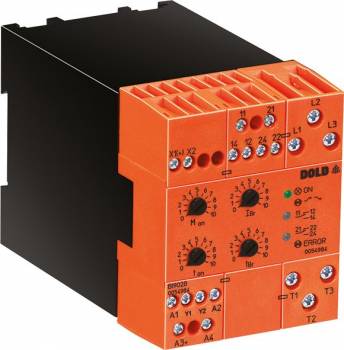
Dold 0055322 BI9028.38/001 soft start brake 11 kW DC24V
| Lieske Part No. | 1583170 |
|---|---|
| Mfg Part No | 0055322 |
| EAN-Code | 4030641553227 |
| Manufacturer | Dold |
| Here only | 679,74 EUR
808,89 EUR incl. VAT
|
Further information for Dold 0055322 BI9028.38/001 soft start brake 11 kW DC24V
| Technical data | |
| Extra functions | Mains monitoring, Temperature monitoring |
| For three-phase motors, 400 V up to | 15 kW |
| Load voltage up to | 3AC 480 V |
| Width | 90 mm |
| Type | BI 9028 |
| Auxiliary voltage required | |
| Signalling output | |
| Variant | |
| Auxiliary voltage | AC 230 V |
| Contact equipping | 2 x 1 changeover contact |
| Mains / motor voltage | 3AC 200 - 480 V |
| Nominal motor power | 11 kW |
| Approvals and Markings | UKCA |
| Variant | Volt free contacts for Start (X1/X4) and Stop (X3/X4) or motor on (x1/x4) and brake on (X3/X4) |
Applications
This device is suitable for machines with gear, belt, and chain drives, as well as for conveyor belts, fans, pumps, compressors, woodworking machines, centrifuges, packaging machines, and door drives. In these applications, it ensures a soft start, protecting mechanical components, and enables controlled braking to avoid unwanted movements or damage.
Functions and Equipment in Detail
The BI9028.38/001 operates with a 2-phase motor control, where two motor phases are controlled via thyristors to gradually increase current and torque. This ensures a smooth motor acceleration. The start and brake time, as well as the start and brake torque, can be adjusted independently. Control is performed via potential-free contacts for Start (X1/X4) and Stop (X3/X4) or Motor On (X1/X4) and Brake On (X3/X4). The contact configuration includes 2 x 1 changeover contacts. A galvanically isolated control input with a voltage range up to AC/DC 230 V allows flexible integration into existing control systems.
Technology Explained Simply
The power electronics of the device use phase-cut control, where the voltage applied to the motor phases is gradually increased to control the current and torque during acceleration. This prevents high inrush currents and mechanical stress. The braking function is also achieved through electronic control of the motor phases, enabling controlled deceleration. Network monitoring detects phase loss and incorrect phase sequence to prevent damage. Temperature monitoring allows motor temperature detection via a thermistor (P1/P2/P3), though this function is only available in certain variants.
Compatibility and Accessories
The device is designed for 3-phase motors and requires an auxiliary voltage of AC 230 V. It is equipped with three auxiliary voltages up to 230 V, one of which is available as DC 24 V. Control is performed via terminals X1 to X4, with Start and Stop signals transmitted via potential-free contacts. Status and fault indication are provided via two alarm relays (contacts 11-12-14 and 21-22-24) and LED indicators. The width is 90 mm, making it suitable for installation in enclosures.
Mounting and Installation
Mounting is carried out in an enclosure, taking into account the width of 90 mm. Wiring is done via designated connection terminals: L1, L2, L3 for network voltage, T1, T2, T3 for motor connection, A1/A2 for auxiliary voltage, A3(+)/A4 for DC 24 V auxiliary voltage, and X1 to X4 for control. The LED indicators (green and yellow) provide visual status indication. Settings for start and brake time and torque are adjusted via the control elements on the device.
Operational Advantages
The device enables soft starting and controlled braking in a single unit, extending the service life of drive components. Simple wiring and space-saving integration of start and brake functions into one device reduce installation and maintenance costs. Network and temperature monitoring increase operational safety. Galvanic isolation of the control input and support for AC/DC 230 V expand application possibilities in various control environments. LED indicators and alarm relays allow quick fault diagnosis and status monitoring during operation.

This is an offer of:
79279 Vörstetten
https://industry-electronics.com
Tel. 07666/88499-0
Fax. 07666/88499-111
Diesen Artikel finden Sie unter:
industry-electronics.com/artikel/1583170

Lieske Elektronik e.K.
Reutener Str. 1079279 Vörstetten
https://industry-electronics.com
Tel. 07666/88499-0
Fax. 07666/88499-111
Diesen Artikel finden Sie unter:
industry-electronics.com/artikel/1583170