
Dold 0055117 differential current transformer ND5019/070WN1227.052.660
Industrial Material > Industrial relays and contactors > Electronic modules
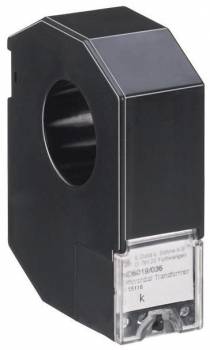
Dold 0055117 differential current transformer ND5019/070WN1227.052.660
| Lieske Part No. | 851237 |
|---|---|
| Mfg Part No | 0055117 |
| EAN-Code | 4030641551179 |
| Manufacturer | Dold |
| Here only | 155,94 EUR
185,57 EUR incl. VAT
|
Further information for Dold 0055117 differential current transformer ND5019/070WN1227.052.660
| Technical data | |
| Diameter | 70 mm, 105 mm |
| For relay type | IL 5882, SL 5882 |
| Type | ND 5019 |
| Variant | |
| Variant | 70 mm inner diameter |
Applications
The differential current transformer ND5019 is used in industrial and installation applications where continuous monitoring of insulation quality is required. It is suitable for installations operating with alternating and pulsating direct currents, and complies with the standard IEC/EN 62020. The application is in earthed networks, where fault current flows to ground. Early detection of insulation deterioration enables preventive maintenance measures to avoid damage.
Functions and Equipment in Detail
The transformer has an inner diameter of 70 mm and an overall diameter of 105 mm. It is connected to the differential current monitor via terminals i and k, with all conductors of the monitored circuit (except PE) passing through the transformer. In a fault-free condition, the sum of all currents is zero, so no voltage is induced in the transformer. In case of an insulation fault, fault current flows to ground, creating a current difference that the transformer detects. The evaluation is carried out by the connected differential current monitor, which indicates the fault. The transformer features wire break detection, ensuring that a broken conductor in the measuring circuit does not cause malfunction.
Technology Explained Simply
The ND5019 operates on the principle of differential current measurement. It measures the difference between incoming and outgoing current in a circuit. In case of an insulation fault, part of the current flows to ground, causing an imbalance in current flow. This imbalance is detected by the transformer and transmitted to the differential current monitor. The measurement is performed in the frequency range of 20 to 2000 Hz, making it suitable for alternating and pulsating direct currents. The short response time enables rapid fault detection. Indication is provided via LED indicators on the differential current monitor, showing the operating status (auxiliary voltage, pre-warning, alarm).
Compatibility and Accessories
The differential current transformer ND5019/070 is specifically developed for use with differential current monitors IL 5882 and SL 5882. These devices are available in two housing forms: IL 5882 with 63 mm depth and bottom-mounted terminals for installation and industrial distributors, and SL 5882 with 100 mm depth and top-mounted terminals for enclosures with mounting plate. The transformer can also be combined with other external differential current transformers such as ND 5016 or the hinged current transformer ND 5014, provided the connection terminals are compatible.
Mounting and Installation
Mounting is done by installing the transformer in the circuit, with all conductors (except PE) passing through the inner diameter of 70 mm. The connection terminals i and k of the transformer are connected to the corresponding terminals of the differential current monitor. Installation must comply with the requirements of DIN 43880. Positioning must ensure that the transformer is not mechanically stressed and cable connections are clean and secure.
Advantages in Operation
The use of the differential current transformer ND5019 enables continuous monitoring of insulation quality, increasing the availability of the installation. Early fault detection reduces the risk of fires and installation damage. Wire break detection ensures reliable measurement, even if a conductor in the measuring circuit is broken. The short response time and adjustable response delay allow precise adaptation to the specific requirements of the installation. The LED indicators on the differential current monitor provide clear visual feedback on the operating status.

This is an offer of:
79279 Vörstetten
https://industry-electronics.com
Tel. 07666/88499-0
Fax. 07666/88499-111
Diesen Artikel finden Sie unter:
industry-electronics.com/artikel/851237

Lieske Elektronik e.K.
Reutener Str. 1079279 Vörstetten
https://industry-electronics.com
Tel. 07666/88499-0
Fax. 07666/88499-111
Diesen Artikel finden Sie unter:
industry-electronics.com/artikel/851237