
Dold 0054675 voltage relay AC50-500V
Industrial Material > Industrial relays and contactors > Switching units / measuring, control relay
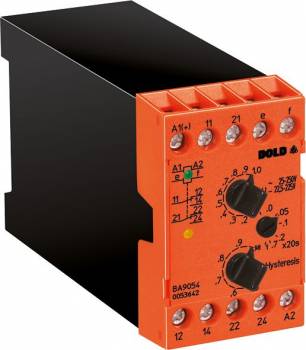
Dold 0054675 voltage relay AC50-500V
| Lieske Part No. | 1312784 |
|---|---|
| Mfg Part No | 0054675 |
| EAN-Code | 4030641546755 |
| Manufacturer | Dold |
| Here only | 279,93 EUR
333,12 EUR incl. VAT
|
Further information for Dold 0054675 voltage relay AC50-500V
| Technical data | |
| 1- / 3-phase | 1 |
| Enclosure design | Switch cabinet |
| Nominal voltage max. | AC 1000 V, DC 900 V |
| Output contacts | 2 C/O contacts |
| Width | 45 mm |
| Type | BA 9054 |
| Operate delay | |
| Variant | |
| Auxiliary voltage | AC 230 V |
| Contact equipping | 2 changeover contacts |
| Measuring range | AC 50 - 500 V |
| Start up delay | 1 - 20 s |
| Switching delay | 0 - 2 s |
| Approvals and Markings | UKCA, CCC |
| Variant | Undervoltage relay. De-energized on trip. Time delay at hysteresis value |
Applications
This relay is designed for use in industrial and railway applications, where high operational safety and reliability of electrical systems are required. It monitors both DC and AC voltages and is particularly suitable for protecting devices from damage due to overvoltage. Early fault detection enables preventive maintenance measures and contributes to increased productivity by avoiding unexpected downtimes.
Functions and Equipment in Detail
The device features two changeover contacts, which can be used to control auxiliary circuits. The auxiliary voltage is AC 230 V, and the auxiliary circuit is galvanically separated from the measurement circuit, ensuring high safety and immunity to interference. The start-up bypass time is 1 to 20 seconds and activates only once upon application of the auxiliary voltage, preventing unwanted tripping during machine or system start-up. The switching delay is 0 to 2 seconds and delays switching after exceeding a threshold value — in the case of an undervoltage relay, after falling below the hysteresis value.
Technology Explained Simply
The relay measures the arithmetic mean of the rectified measurement voltage. The devices are calibrated for sinusoidal AC voltages in RMS value, enabling accurate measurement even under real network conditions. Adjustment is performed via rotary switches, allowing both the pickup value and the hysteresis value to be manually set. The hysteresis depends on the set pickup value to ensure stable switching behavior. LED indicators signal operational readiness (green LED) and activation of the output relay (yellow LED), enabling quick visual inspection of the operating status.
Compatibility and Accessories
The device is designed for use in enclosures and complies with standards IEC/EN 60255-1 and IEC/EN 60947-1. The width is 45 mm, allowing compact mounting in standard control panels. The maximum rated voltage is AC 1000 V and DC 900 V, with the device designed for the measurement range of AC 50 to 500 V. The measurement frequency can reach up to 5 kHz, enabling use in systems with high frequencies. The certifications UKCA and CCC are valid for the respective variant.
Mounting and Installation
Mounting is performed in an enclosure, with terminal markings A1/A2 for the auxiliary voltage, e/f for the voltage measurement input, and 11/12/14 as well as 21/22/24 for the two changeover contacts. The connection terminals are clearly labeled to ensure error-free installation. The devices are designed for mounting on DIN rails, with the width of 45 mm enabling standardization in industrial control systems.
Operational Advantages
The galvanic separation between the auxiliary and measurement circuits ensures high immunity to interference. The start-up bypass prevents unwanted tripping during start-up, while the switching delay ensures stable response to short-term voltage fluctuations. The LED indicators allow for quick visual monitoring of the operating status. Precise and reliable measurement ensures high operational safety and reduces the likelihood of false alarms.

This is an offer of:
79279 Vörstetten
https://industry-electronics.com
Tel. 07666/88499-0
Fax. 07666/88499-111
Diesen Artikel finden Sie unter:
industry-electronics.com/artikel/1312784

Lieske Elektronik e.K.
Reutener Str. 1079279 Vörstetten
https://industry-electronics.com
Tel. 07666/88499-0
Fax. 07666/88499-111
Diesen Artikel finden Sie unter:
industry-electronics.com/artikel/1312784