
Dold 0054462 time relay delayed release AC/DC24-240V 1.5-30S
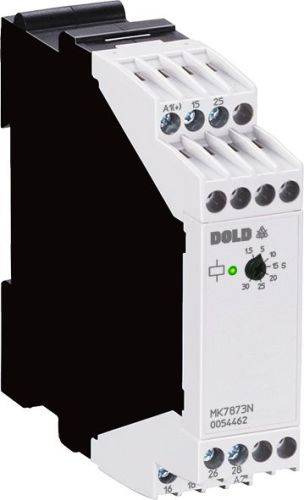
Dold 0054462 time relay delayed release AC/DC24-240V 1.5-30S
| Lieske Part No. | 1002431 |
|---|---|
| Mfg Part No | 0054462 |
| EAN-Code | 4030641544621 |
| Manufacturer | Dold |
| Here only | 160,85 EUR
191,41 EUR incl. VAT
|
Further information for Dold 0054462 time relay delayed release AC/DC24-240V 1.5-30S
| Technical data | |
| Approvals | UL |
| Enclosure design | Switch cabinet |
| Output contacts | 2 C/O contacts |
| Time function(s) | Off-delay, without control signal |
| Width | 22,5 mm |
| Type | MK 7873N |
| Variant | |
| Contact equipping | 2 changeover contacts delayed |
| Nominal voltage | AC/DC 24 - 240 V |
| Terminal type | fixed terminal blocks with screw terminals |
| Time range | 1,5 - 30 s |
| Approvals and Markings | UL-listed C/US, UKCA |
| Variant | Release delay, without control signal |
Applications
This time relay is designed for use in industrial and railway applications where a delayed reset is required after switching off the control signal. It is suitable, for example, for controlling drives, lighting systems, or safety functions where controlled or time-delayed switching off of loads is necessary. The zero-voltage safety ensures that the relay returns safely to its initial position in the event of a power failure.
Functions and Features in Detail
The time function is drop-out delayed, meaning that the contacts return to their resting position not immediately, but after a set delay time (1.5 to 30 s) following the deactivation of the control signal. The delay time can be adjusted within the specified range. The device operates without a re-arm time, meaning it immediately starts the delay phase after the control signal is switched off. The LED indicator displays the supply voltage, which is helpful during commissioning and maintenance.
Technology Explained Simply
The relay uses an electromechanical time function implemented by an integrated timing mechanism. The delay is achieved through a mechanical reset delay, which is activated independently of the control signal. The contacts are configured as changeover contacts, meaning they can switch between two positions (e.g., open and closed). The screw terminals allow for a secure and durable connection of the wiring. The module width of 22.5 mm corresponds to the standard for enclosure components and enables compact installation.
Compatibility and Accessories
The device is designed for operating voltages in the range AC/DC 24 to 240 V and can be used in various industrial control systems. It is certified with approvals such as UL-listed C/US and UKCA, enabling use in corresponding markets. Optional plug-in terminal blocks are available, allowing for quick replacement of the relay. The terminal connections are designed for use with stranded and solid conductors in accordance with DIN 46228.
Mounting and Installation
The relay is mounted in an enclosure and connected to control and load circuits via the screw terminals. Mounting is carried out in the usual manner for enclosure components. The LED indicator allows for visual verification of the supply voltage. The delay time is adjusted using an adjustment knob on the device, which is accessible during operation.
Operational Advantages
The drop-out delayed function enables controlled switching off of loads, which is required in many industrial processes. The high repeat accuracy of < ± 0.5 % ensures reliable and reproducible time delays. The zero-voltage safety guarantees that the relay returns safely to its initial position in the event of a power failure. The LED indicator simplifies diagnosis and maintenance. The module width of 22.5 mm allows for compact integration into existing control systems.

This is an offer of:
79279 Vörstetten
https://industry-electronics.com
Tel. 07666/88499-0
Fax. 07666/88499-111
Diesen Artikel finden Sie unter:
industry-electronics.com/artikel/1002431

Lieske Elektronik e.K.
Reutener Str. 1079279 Vörstetten
https://industry-electronics.com
Tel. 07666/88499-0
Fax. 07666/88499-111
Diesen Artikel finden Sie unter:
industry-electronics.com/artikel/1002431