
Dold 0054259 semiconductor contactor 3xAC 10A
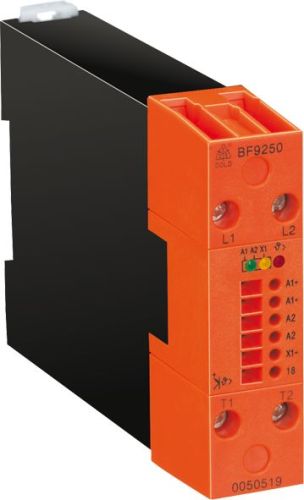
Dold 0054259 semiconductor contactor 3xAC 10A
| Lieske Part No. | 1001442 |
|---|---|
| Mfg Part No | 0054259 |
| EAN-Code | 4030641542597 |
| Manufacturer | Dold |
| Here only | 323,16 EUR
384,56 EUR incl. VAT
|
Further information for Dold 0054259 semiconductor contactor 3xAC 10A
| Technical data | |
| Approvals | UL |
| Load current up to | 50 A |
| Load voltage up to | AC 480 V |
| Number of poles | 1-pole, 2-pole, 3-pole |
| On/Off Input Control | AC/DC, DC |
| Width | 22,5 mm, 45 mm, 90 mm |
| Type | BF 9250 |
| Signalling output | |
| Temperature monitoring | |
| Variant | |
| Auxiliary voltage | AC/DC 110 - 230 V |
| Contact equipping | with signal contact |
| Load current | 3 x AC 10 A |
| Load voltage | AC 24 - 480 V |
| Semiconductor output | 3-pole |
| Approvals and Markings | UL-listed C/US |
| Variant | Switching at zero crossing. |
Applications
This contactor is designed for use in installations requiring disturbance-free and wear-free switching. Typical applications include controlling electric heaters, drive motors, pneumatic or hydraulic valves, and lighting systems. The zero-voltage switching ensures that the switching operation occurs at the zero crossing of the alternating voltage, minimizing spark generation and electromagnetic interference. This is particularly important in sensitive environments where interference could affect other electronic devices.
Functions and Features in Detail
The device includes temperature monitoring of the power semiconductors, serving as a protective function. In case of overheating, an alarm output is activated via a normally open contact (terminals 11/12), triggering a warning or shutdown. This enhances operational safety and prevents damage from thermal overload. Protection is provided by varistors, which suppress overvoltages in the network and extend the device’s lifespan. The integrated LED indicator (green for operating voltage, red for temperature alarm) enables visual monitoring of the operational status.
Technology Explained Simply
The BF9250.03 operates as a zero-voltage switching device, meaning the switching action occurs precisely at the zero crossing of the alternating voltage. This reduces electrical interference and extends the lifespan of the semiconductors. The load voltage up to AC 480 V and load current up to 50 A (in other variants) make the device suitable for a wide range of applications. The width of 90 mm allows mounting on a DIN rail, ensuring standardized installation in enclosures. The low current consumption of the control input X1 makes the device particularly suitable for control via PLC systems.
Compatibility and Accessories
The device complies with standards IEC/EN 60947-4-2 and IEC/EN 60947-4-3, confirming adherence to international standards for electrical switching devices. It is UL-listed C/US, certifying its approval for use in the USA and Canada. The 90 mm width is part of the BF 9250 series, which is also available in 22.5 mm and 45 mm widths, allowing flexible adaptation to different enclosure sizes. Combination with other BF 9250 models in the same enclosure is possible, as all models are mounted on DIN rails.
Mounting and Installation
Mounting is done on a DIN rail, enabling quick and secure installation in enclosures. The terminals are clearly labeled (L1/L2/L3 for supply, T1/T2/T3 for load, A1/A2 for control, X1 for optional control input, 18 for alarm output, 11/12 for normally open contact). The terminals are designed for cable connections, with a maximum short-circuit current rating of 400 A (for the 3-pole variant). Installation requires no additional tools, as DIN rail mounting is standardized.
Operational Advantages
The device offers wear-free operation, as it contains no mechanical contacts. Noiseless switching and minimized interference emission are advantages over mechanical relays. The integrated temperature monitoring and alarm output enhance operational safety. Control via PLC is possible, facilitating integration into automated systems. Certification to IEC/EN 60947-4-2/4-3 and UL-listed C/US ensures suitability for use in various markets.

This is an offer of:
79279 Vörstetten
https://industry-electronics.com
Tel. 07666/88499-0
Fax. 07666/88499-111
Diesen Artikel finden Sie unter:
industry-electronics.com/artikel/1001442

Lieske Elektronik e.K.
Reutener Str. 1079279 Vörstetten
https://industry-electronics.com
Tel. 07666/88499-0
Fax. 07666/88499-111
Diesen Artikel finden Sie unter:
industry-electronics.com/artikel/1001442